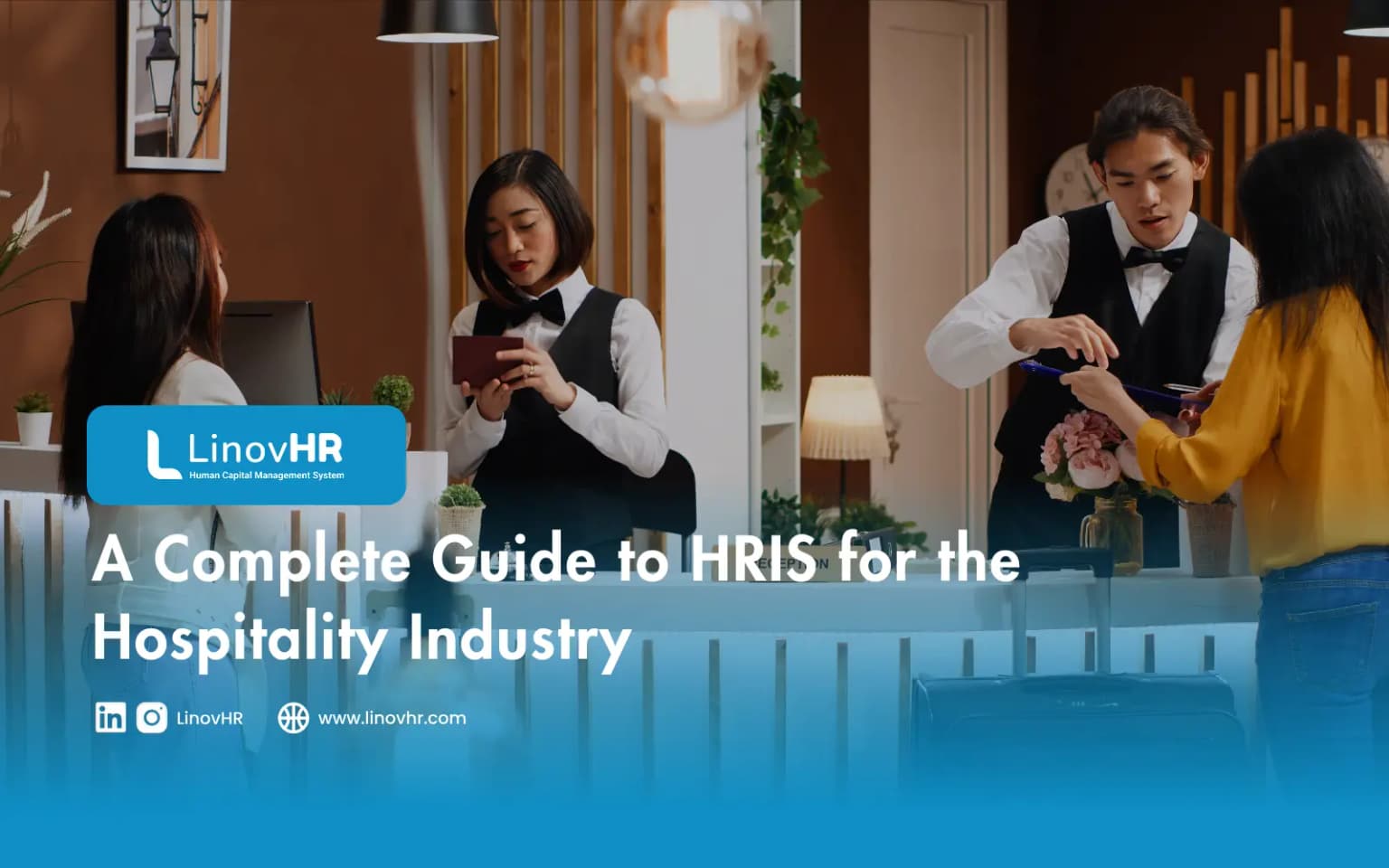
HRIS for the hospitality industry is a tool designed to simplify HR management for hotels, lodges, resorts, and other accommodation businesses.
This system isn’t just an administrative tool, it’s also the foundation for maintaining service quality and workforce efficiency.
This matters because hospitality operations run almost around the clock and face unpredictable peak seasons, meaning companies need a system that can simplify how they manage it all.
This thought leadership article breaks down in detail why using an HRIS has become a necessity for hospitality businesses.
Key Takeaways
- HRIS for the hospitality industry is a system designed to simplify HR management for hotels, resorts, and other accommodation businesses.
- HRIS simplifies automated shift scheduling, early detection of turnover and burnout patterns, faster recruitment, and employee self-service that boosts employee engagement.
- Must-have HRIS features include attendance management, automated shift scheduling, integrated payroll, fast recruitment, employee self-service, and data-driven HR analytics.
- When choosing a vendor, prioritize scalability, the ability to handle multi-property shifts, payroll integration, and compliance with Indonesian labor regulations.
What Is HRIS for the Hospitality Industry?
HRIS for the hospitality industry is a digital system that helps hotel and lodging companies manage their entire HR process on a single platform.
Hospitality HRIS is built to handle the complexity of round-the-clock operations, covering everything from employee data and cross-shift attendance to scheduling, leave, overtime, payroll (including service charges and tips), and HR reports for management’s strategic needs.
With one integrated platform, HR teams no longer need to juggle attendance spreadsheets, separate payroll applications, and physical employee records.
All data is stored and interconnected, making administrative processes faster, more accurate, and easier to trace whenever needed.
Characteristics of HR in the Hospitality Industry
Before diving deeper into the role of HRIS in hospitality, it’s worth understanding what sets HR management in this industry apart from other sectors:
- Labor-intensive and multi-departmental: A single hotel property can employ anywhere from dozens to hundreds of people spread across front office, housekeeping, F&B, engineering, and sales & marketing, each with its own working pattern.
- 24/7, shift-based operations: Nearly all frontline staff work in shifts, including overnight shifts, which require far more complex scheduling than a typical office job.
- Seasonal nature of work: Staffing needs can spike sharply during high season or long holidays, then drop just as sharply during low season.
- A unique pay structure: Beyond base salary, hospitality employees typically receive non-wage components like service charges and tips, which must be calculated and distributed according to applicable rules.
- A frontline-dominated workforce: Most employees interact directly with guests and work on the floor rather than behind a desk, so access to HR systems ideally needs to be mobile-friendly.
Summary
| Aspect | Coverage |
|---|---|
| Main function of hospitality HRIS | Employee data, attendance, shifts, leave, overtime, payroll, HR reporting |
| Hospitality HR characteristics | Labor-intensive, 24/7 shifts, seasonal, unique pay structure, frontline-dominated workforce |
Why Does HR Management in the Hospitality Industry Need a Different Approach?
HR management in the hospitality industry can’t be compared to industries with more stable operations.
In hotels and lodging businesses, guest demand can shift at any moment, and staffing needs shift right along with it.
Occupancy might be high one day, drop the next, then climb again because of an event or holiday season. As a result, HR teams need to be ready with far more flexible workforce planning. That’s why it’s essential to understand the challenges HR teams in hospitality commonly face. Here’s a closer look:
The Complexity of 24/7, Seasonal, Cross-Department, and Cross-Property Shift Work
Non-stop shift rotations create operational challenges all their own.
According to a 2023 McKinsey report, jobs in the tourism sector, including hospitality, tend to be informal due to the prevalence of specific seasons and weak regulation.
This drives long working hours, irregular shifts, and part-time status that’s far more common here than in other sectors.
Managing work hours with manual spreadsheets raises the risk of schedule conflicts or staff fatigue from back-to-back shifts, such as a night shift immediately followed by a morning shift the next day.
Companies with multiple properties face an added layer of complexity on top of this. When shift assignments are still handled manually, it increases the risk of uneven task distribution across the workforce.
Employee Turnover Far Above the Average of Other Industries
Turnover is one of the most persistent HR challenges in the hospitality industry.
Research by Jung Woo Han (2020) found that turnover rates in the hospitality sector reach 60% to 120% per year. That figure shows just how high resignation rates are among hospitality employees in Indonesia.
This high turnover forces companies to constantly recruit and train new staff, which takes a heavy toll on the budget.
Labor Shortages and Fierce Global Competition for Talent
High turnover doesn’t just drain the budget, it also makes it harder to find competent replacements.
A 2025 report from the World Travel & Tourism Council states that the global hospitality industry will face a shortage of 8.6 million workers by 2035, meaning the industry will be operating roughly 18% below ideal staffing levels.
This points to a significant year-over-year decline in competent talent across the hospitality industry, which can ultimately affect service quality.
The Digital Skills Gap and Technology/AI Readiness
Today, a growing number of job roles rely on AI to simplify and speed up work. In hospitality, AI can be applied to tasks such as automated guest scheduling, customer service chatbots, and various other roles.
A 2026 Deloitte report states that hospitality companies need to start using AI to automate basic tasks like customer service, guest scheduling, and other processes that demand speed.
Unfortunately, the hospitality workforce is actually falling behind other industries when it comes to AI skills.
Data from Hospitality Technology in 2026 shows that, surprisingly, the hospitality sector has the largest AI skills gap of any major industry, ahead of even healthcare and financial services.
Burnout and a Mental Health Toll That Often Goes Unnoticed
High service demands combined with understaffing create a real risk of a high-stress work environment.
Data from The Caterer in 2025 found that 62% of junior hospitality workers see burnout as simply “part of the job.” The report also notes that limited resources and understaffing make workloads even heavier, and this is a major contributor to high turnover.
Steadily Declining Employee Engagement
Excessive employee fatigue can create problems that directly affect service quality. Burnout can cause employees to stop giving their full effort and to focus only on themselves.
High work stress can also trigger low employee engagement with the company. Employees who don’t feel “connected” to their work won’t perform at their best when serving guests.
Gallup’s “State of the Global Workplace 2026” survey found that global employee engagement dropped to 20% in 2025, the lowest level since the 2020 pandemic. The estimated global productivity loss from this reaches USD 10 trillion. In service-based industries especially, disengaged employees can be the first sign of a company’s decline.
Summary
| Challenge | Root Cause |
|---|---|
| Complex shift work | Non-stop working hours |
| High turnover | High work pressure and burnout |
| Labor shortages | High turnover rates |
| Weak AI skills | Lack of training and overreliance on in-person service |
| High burnout | High work pressure and understaffing |
| Low employee engagement | Burnout and high work stress |
Why Does HRIS Play a Vital Role in Hospitality Businesses?
Given all these challenges, manual approaches clearly can’t be the answer anymore.
What’s needed is a system that can automate HR tasks and simplify administrative work. This is where HRIS comes in, acting as the bridge between operational problems and systematic solutions.
Simplifying Non-Stop Shift Scheduling
To solve the scheduling challenges outlined above, HRIS software includes a shift management feature.
This feature lets HR teams map shift requirements accurately, avoid overlapping assignments, and prevent violations of working-hour regulations. A smart system can distribute workloads fairly, without relying on the limits of human memory. HRIS also helps identify manpower needs by department, so shifts can be planned more accurately.
In a case study of LinovHR client The Rich Jogja Hotel, shift scheduling was identified as the company’s biggest challenge. With such an unpredictable work schedule, managing it manually had become extremely complicated.
After adopting LinovHR’s Time Management module, The Rich Hotel’s HR team could easily build more flexible schedules that the system recorded automatically. Their scheduling is also integrated with LinovHR’s Payroll module, so attendance records flow straight into payroll, cutting down on errors in calculating salaries, bonuses, service charges, tips, PPh 21 income tax, and BPJS social security contributions.
Reducing Employee Turnover
HRIS can help identify the patterns behind high resignation rates, such as excessive overtime or uneven shift distribution.
With an HRIS in place, HR teams can take preventive action earlier, before turnover starts climbing. Well-organized historical attendance and performance data also makes exit interviews and root-cause analysis easier, especially important for an industry where turnover can reach 60–120% a year in Indonesia.
Addressing Labor Shortages with Quality Talent
HRIS recruitment and onboarding modules make it much faster to fill open positions, while also building a talent pool database for seasonal needs.
With WTTC data pointing to a potential shortage of millions of hospitality workers globally by 2035, recruitment speed becomes a genuine competitive edge for businesses that can move faster than their rivals.
Helping Employees Become More Digitally Literate and AI-Ready
With a simple, mobile-friendly user interface, HRIS actually gives frontline employees a great starting point for getting comfortable with digital systems.
By getting staff used to a mobile app (Employee Self-Service) for attendance and leave requests, companies can build a strong digital culture that lays the groundwork for broader digitalization. This matters because hospitality has the largest AI skills gap of any industry, so gradual adaptation through HRIS can smooth out the overall digital transition.
Reducing Employee Burnout
One key HRIS feature is analytics reporting, which can flag early warning signs of burnout like excessive overtime patterns or declining attendance before they take a heavier toll on employees’ mental health.
With fairer, more transparent shift distribution, workloads that have long been a source of tension can start being managed more proportionally.
Boosting Employee Engagement
In hospitality, healthy engagement usually shows up as consistent service quality, strong teamwork, and a more positive guest experience.
With employee self-service, staff have control over their own data, from submitting leave requests to checking pay slips without relying on manual paperwork. That transparency and convenience can make employees feel more valued and included, which builds trust and a stronger sense of security.
Summary
| Challenge | Role of HRIS |
|---|---|
| 24/7 & seasonal shifts | Automated scheduling across departments and properties |
| High turnover | Detecting resignation patterns and providing data to support retention |
| Labor shortages | Faster recruitment and onboarding |
| Digital/AI gap | A starting point for frontline employees’ digital adaptation |
| Burnout | Analytics reports that flag workload issues and support fair shift distribution |
| Declining employee engagement | Employee self-service for greater transparency |
Must-Have HRIS Features for Hospitality Businesses
Now that we’ve covered how HRIS solves HR challenges in hospitality, it’s worth knowing which features are needed to support this business’s day-to-day operations. Here are the key features to look for in an HRIS for hospitality businesses.
Attendance Management

The attendance management feature records employee attendance accurately. Ideally, it should include GPS validation or face recognition, since many hospitality employees work on-site and across multiple locations.
Accurate attendance data forms the basis for precise, error-free payroll calculations.
This feature is already in use among LinovHR’s hospitality clients. The online Attendance feature makes it easier and more flexible for frontline employees to clock in and out, and it’s connected to the Payroll module, which automatically records employee attendance, making wage calculations easier and less prone to error.
Automated Shift Scheduling

One of the most critical HRIS capabilities for hospitality is the ability to automatically build shift schedules for hundreds of employees across departments.
This feature should include real-time schedule-change notifications, so frontline staff get instant updates given how non-stop hospitality operations can be.
The Rich Jogja Hotel, a LinovHR client, is a good example. Since scheduling was their biggest pain point, this feature proved especially valuable.
After adopting LinovHR’s Time Management module, they found it far easier to manage flexible, unpredictable shift schedules.
Integrated Payroll (Service Charges, Tips, Overtime, and Regulatory Compliance)

Payroll in the hospitality industry is more complex than in most other sectors, since it includes non-wage components like service charges and tips on top of overtime and tax deductions.
In Indonesia, service charge distribution is governed by Manpower Ministerial Regulation No. 7 of 2016 on Service Charges in Hotel and Restaurant Businesses (Permenaker No. 7/2016), which requires the bulk of the service fund to be distributed to employees transparently and fairly.
A good HRIS can automate all of these calculations, helping companies stay compliant while minimizing the risk of errors.
One LinovHR hospitality client, for example, uses the Payroll module to simplify its entire payroll process, making it easy to calculate every salary component, from base pay and allowances to service charges, tips, PPh 21 income tax, and BPJS contributions.
With more accurate payroll calculations, the company avoids costly errors while staying compliant with payroll regulations.
Fast Recruitment and Onboarding for High-Volume Hiring Needs

Recruitment and onboarding is another must-have feature for hospitality HRIS.
It usually comes with an Applicant Tracking System (ATS) and digital onboarding, which speed up hiring, especially when staffing needs spike during peak season without sacrificing the quality of the selection process.
Employee Self-Service for Frontline Workers

With Employee Self-Service (ESS), employees can request leave, check pay slips, and view their own shift schedules right from a mobile app.
This feature reduces the administrative load on HR teams while increasing transparency for frontline employees who are constantly working on the floor.
Data-Driven HR Analytics and Reporting for Strategic Business Needs

The last relevant HRIS feature for hospitality businesses is the analytics dashboard. Analytics reports provide a real-time view of turnover, overtime trends, and labor cost distribution by department or property. With analytics in place, management can make strategic decisions based on data rather than guesswork.
Summary
- GPS/face recognition-based attendance management
- Automated shift scheduling across departments
- Integrated payroll covering service charges, tips, overtime, and regulatory compliance
- Fast recruitment & onboarding
- Employee self-service for frontline staff
- Data-driven HR analytics and reporting for strategic needs
How to Choose the Right HRIS for Your Hospitality Business
Once you know which features you need, the next step is learning how to choose the right HRIS vendor for your hospitality business. Here are a few things to check before choosing an HRIS for your hotel or lodging business.
Consider Software Scalability to Support Business Growth
The first step in choosing an HRIS vendor is making sure the system can accommodate a growing headcount and new properties without requiring a system migration from scratch.
Choosing a highly scalable vendor saves money in the long run, compared to switching vendors every time the business grows.
Test the Software’s Ability to Handle Complex, Multi-Property Shifts
Before fully implementing an HRIS, request a demo to see how the system handles real-world scheduling scenarios such as rotating shifts, last-minute leave requests, and coordination across properties within the same hotel group.
If the vendor you’re testing can handle these scenarios well, the system is ready and well-suited for your hospitality business.
Check the Software’s Payroll Integration Capabilities
Payroll calculations in hospitality are far more complex than in most other industries. Make sure the HRIS can automatically calculate hospitality-specific payroll components like service charges, tips, and overtime.
Integration with PPh 21 income tax and BPJS calculations matters too, so you’re not stuck handling extra manual processes.
Verify the Vendor’s Compliance with Indonesian Regulations
Beyond the points above, you also need a system that supports compliance with Indonesian regulations.
Local vendors are typically quicker to update their systems in response to changes in Indonesian labor and tax regulations, including service charge rules for hotels and restaurants, compared to global vendors based overseas.
Summary
| Criteria | What to Check |
|---|---|
| Scalability | Able to accommodate growth in employees and properties |
| Shift management | Proven ability to handle complex, multi-property shifts |
| Payroll integration | Supports calculation of service charges, tips, overtime, PPh 21, and BPJS |
| Regulatory compliance | Aligned with Indonesian labor regulations |
Steps to Implement HRIS in a Hospitality Company
Once you’ve found the right vendor, it’s worth understanding the stages of implementing HRIS at a hospitality business. These steps exist to ensure the HRIS runs smoothly without disrupting day-to-day operations.
Here’s how HRIS implementation typically unfolds at a hospitality company.
Analyze Company Problems and Needs
Before choosing a vendor, first identify the specific HR problems your company is facing. This helps ensure the features you choose are genuinely relevant to your needs.
Choose a Vendor That Fits Your Needs
After identifying your HR challenges, choose a vendor with the capacity to address them. You can also request a product demo first to check whether the system truly fits your needs.
Use selection criteria based on your core challenges like scalability, shift-handling capability, payroll integration, and regulatory compliance as your benchmark for comparing vendors before deciding.
Migrate Data to the Newly Implemented System
Once you’ve found the right vendor, the next step is migrating your data into the newly implemented system.
Make sure employee data, attendance history, and payroll records are transferred accurately and securely. Ideally, the vendor’s technical team should support this migration to prevent data loss or synchronization issues.
Train Employees (Both Office and Frontline Staff)
Once data migration is complete, the next step is training all employees on the new system.
Training for office staff and frontline staff should be handled separately, though, given their different roles and different comfort levels with digital technology. Use short, visual training formats that are easy for field staff to follow, since they have little free time between shifts.
Continuous Evaluation and Optimization
Implementing HRIS at a hospitality business isn’t a one-and-done project. Even once implementation is complete, you’ll need to run regular evaluations.
Evaluate and optimize how the system is being used, gather feedback from employees, and adjust the configuration as the business grows or regulations change.
Summary
- Analyze company problems and needs
- Choose a vendor that fits your needs
- Migrate data to the new system
- Train employees (office and frontline)
- Continuous evaluation and optimization
Build Modern HR Management for Your Hospitality Business with LinovHR
The hospitality industry places real demands on every stakeholder to be fast, precise, and flexible. That’s why manual HR management is no longer a fit for such a dynamic business.
Companies need a system that can handle shifts, attendance, payroll, recruitment, and reporting within a single, more modern workflow. HRIS for hospitality businesses answers that challenge with one integrated platform.
Among the processes HRIS solves for are automated shift scheduling, payroll that accounts for service charges and tips in line with Indonesian regulations, and employee self-service that boosts engagement among frontline teams.
To get a solution that’s both effective and sustainable for your hotel business, you need a vendor with comprehensive features. LinovHR is one vendor worth considering.
LinovHR is a local HRIS software that understands the operational complexities of hospitality in Indonesia, from payroll calculations covering PPh 21 income tax and BPJS to GPS- and face-recognition-based attendance, backed by a local support team ready to help whenever you need it.
Schedule a free LinovHR demo today, and start building HR management for your hospitality business that’s more efficient, fairer, and ready for whatever the industry brings next.
Frequently Asked Questions (FAQ)
What is HRIS for the hospitality industry?
HRIS for the hospitality industry is a digital system that helps hotels, resorts, and lodging businesses manage their entire HR process such as employee data, attendance, shifts, leave, overtime, payroll, and reporting, all within one integrated platform.
What HRIS features are essential for a hotel business?
Essential features include attendance management, automated shift scheduling, integrated payroll (including service charges and tips), fast recruitment and onboarding, employee self-service, and data-driven HR analytics and reporting.
Can HRIS automatically calculate service charges and tips?
Yes. HRIS designed for hospitality can typically automate the calculation and distribution of service charges and tips according to each company’s scheme, while staying aligned with applicable regulations, such as Permenaker No. 7 of 2016 in Indonesia.
How long does HRIS implementation take for a hospitality company?
Implementation time varies depending on the scale of the business and the complexity of the data being migrated, anywhere from a few weeks for a single property to several months for a hotel group with multiple branches.
Is HRIS suitable for small lodging businesses like guest houses or villas?
Yes. As long as the HRIS you choose offers flexible scalability, small lodging businesses can still take advantage of core features like attendance and payroll, then add more modules as the business grows.