HRIS software for hospitality businesses needs to hold up under a level of operational complexity that few other industries face.
Hotels, resorts, and other lodging businesses have to manage hundreds of frontline employees spread across multiple departments and properties, from front office and housekeeping to food & beverage (F&B) and engineering.
Employee schedules follow a shift system that can change at any time, adjusting to room occupancy rates and operating hours that almost never stop.
On top of that, turnover in this industry tends to run high, so recruitment and onboarding happen far more often than in most other sectors.
These conditions make HRIS software one of the most important systems for keeping hotel operations efficient, accurate, and compliant with regulations.
This lines up with a Deloitte report, which found that 77% of companies consider it very important to reduce inefficient administrative workloads.
Unfortunately, only 48% of companies have actually started taking concrete steps to make that happen. The right HRIS software can often help bridge that gap between intention and execution.
This article covers 10 HRIS software recommendations for hospitality businesses in Indonesia, complete with the pros, cons, and best-fit use case for each option.
Key Takeaways
- Managing hotel HR is highly complex, from dynamic shift systems and high turnover to multi-department and multi-property administration.
- Hotel businesses should prioritize an HRIS with mobile attendance (GPS & geofencing), PMS integration, and payroll that can calculate service charges in line with Manpower Regulation No. 7/2016 (Permenaker 7/2016).
- There’s a wide range of HRIS vendors on the market catering to different scales of need, from lightweight apps for small lodgings to end-to-end platforms that can handle the operations of large hotel groups.
How Did We Choose the HRIS Software on This List?
The list of HRIS software recommendations for hospitality businesses in this article wasn’t put together based on brand popularity or the writer’s personal opinion alone.
We weighed several factors, from user experience and feature completeness to how relevant each system is to hospitality business operations.
User Ratings and Reviews
Rating is one of the benchmarks for gauging how satisfied users are with a piece of HRIS software.
Beyond the rating itself, the number of reviews also factors in, since it reflects a genuine history of real-world app usage.
That said, a high rating backed by only a handful of reviews doesn’t necessarily represent the broader user experience.
That’s why readers are still encouraged to run a trial or a live demo session before making a final decision.
Feature Relevance to Hospitality Business Operations
Beyond ratings, we also assessed how relevant the available features are to hotel operations, which have characteristics that are quite different from most other businesses.
Some of the features we used as benchmarks include:
- Employee database
- Multi-department management
- Shift scheduling
- PMS (Property Management System) integration
- Roster management
- Mobile attendance
- GPS attendance
- Geofencing
- Payroll
- Overtime
- Leave management
- Recruitment
- Onboarding
- Performance management
- Employee self-service
- HR analytics
The more complete and relevant a software’s features are, the more value it brings to supporting day-to-day hotel operations.
Relevance to Indonesian Regulations
Another factor we considered is how well the system aligns with Indonesian labor regulations, given how unique working arrangements are in the hospitality industry.
Some of the regulatory aspects we used as a reference include:
- Income Tax Article 21 (PPh 21) calculation
- BPJS contributions
- Payroll in line with Indonesian regulations
- Overtime calculation in line with Government Regulation No. 35/2021 (PP 35/2021)
- Service charge calculation in line with Manpower Regulation No. 7/2016 (Permenaker 7/2016)
- Hotel shift arrangements in line with PP 35/2021
HRIS software that can automatically handle all of these aspects helps HR teams reduce the risk of calculation errors and labor regulation violations.
Data Sources Used
To keep this assessment objective, this article draws on several different data sources.
G2 served as the primary source for rating scores and user reviews used in writing this article, while feature and offering data for each vendor was verified directly through their official websites.
Summary
| Criteria | What We Assessed |
|---|---|
| User rating & reviews | Satisfaction score and number of reviews on a trusted platform (G2) |
| Feature relevance | How well the features match hospitality operational needs |
| Regulatory compliance | PPh 21, BPJS, overtime, service charge, hotel shift arrangements |
| Data sources | G2 and official vendor websites |
Comparing HRIS Software for Hospitality Businesses
Before diving into each vendor in detail, here’s a quick comparison of 10 HRIS software options well suited to hospitality businesses, complete with standout features and the type of user each is best for.
| Software | Rating | Key Features | Best For |
|---|---|---|---|
| LinovHR | 4.6/5 (12 reviews) | Personnel administration, recruitment & digital onboarding, mobile/GPS/geofencing attendance, shift & overtime management, payroll (PPh 21, BPJS, service charge), performance & learning management | Multi-department hotels, multi-property hotels, resorts with limited internet connectivity |
| Mekari Talenta | 4.8/5 (34 reviews) | Employee database, live attendance (face recognition + geofencing), shift schedule, overtime, payroll, ESS, reporting | Hotels recently migrating from manual systems, small-to-mid-size independent hotels |
| SunFish by DataOn | 4.5/5 (210 reviews) | Multi-country payroll, BPJS, PPh 21, LMS, attendance, shift, recruitment, performance, ESS | National-to-multinational hotel groups, hotels needing corporate-grade data security |
| HashMicro HRM | N/A | Core HR, Hashy AI chatbot, multi-currency & multi-branch payroll, attendance, shift scheduling, leave, recruitment, performance, ESS, ERP integration | Hotel groups needing ERP integration, multi-property hotels |
| Samta | N/A | Native PMS integration, channel manager, booking engine, HRIS, accounting | Boutique hotels, villas, small-to-mid-size independent guesthouses |
| KaryaOne | N/A | Shift management, fingerprint-integrated attendance, payroll with automatic overtime calculation, ESS | Hotels with complex shift patterns, hotels that already have fingerprint scanners |
| Gadjian | N/A | Flexible payroll, attendance, shift, leave, ESS | Small hotels or guesthouses |
| Gaji.id | 5/5 (2 reviews) | Complex daily payroll, BPJS, PPh 21, attendance, shift, recruitment, performance, ESS | Small-to-mid-size hotels with many daily-wage staff |
| KantorKu HRIS | N/A | Recruitment, attendance, payroll, performance, ESS, employee database | Hotels looking for fast digitalization |
| GreatDay HR | 3.3/5 (3 reviews) | Live attendance, payroll, employee database, ESS | Mid-size hotels with frontline staff who rarely use a computer |
10 Best HRIS Software Recommendations for Hospitality Businesses
Each software on this list has its own strengths. Some are better suited to small lodgings, while others are built for enterprise-level hotels. So match your choice to your business scale, operational complexity, and specific HR management needs.
1. LinovHR

LinovHR is HRIS and talent management software that supports the entire hotel HR lifecycle end to end.
That covers everything from recruitment and onboarding to attendance tracking, payroll, and performance evaluation.
LinovHR can be configured to match each business’s specific workflow and needs, especially for hotels with complex organizational structures and administrative procedures.
Because it’s all-in-one, hotels that used to rely on several separate applications for attendance, payroll, and employee data can switch to a single, more centralized system.
Here are some of the LinovHR modules most relevant to hospitality business needs:
- Personnel Administration & Organization Management: Employee data for head office and each property is stored neatly and separately, complete with the organizational structure across departments (front office, housekeeping, F&B, engineering).
- Recruitment Management & Digital Onboarding: Speeds up filling front office, housekeeping, or F&B positions that often sit vacant due to turnover. The digital onboarding process helps new employees quickly get up to speed on hotel service SOPs.
- Mobile Attendance, GPS, Geofencing, & Offline Attendance: Employees can clock in directly from the property within a set radius, and this feature keeps working even when internet signal in resort areas is unstable.
- Shift Management & Overtime Management: Makes it easier to manage round-the-clock shifts across departments, while automatically calculating staff overtime hours.
- Payroll, BPJS, PPh 21, & Hotel Service Charge: Automatically calculates monthly and daily wages, including BPJS and PPh 21 deductions, plus service charge distribution in line with applicable regulations.
- Performance Management & Learning Management: Supports department-level performance evaluation through KPIs, OKRs, or the Balanced Scorecard, while also providing digital training materials on guest service standards.
- Employee Self-Service & HR Analytics: Employees can check their shift schedules and pay slips from their own phones, while head-office management monitors an analytics dashboard covering turnover or labor costs at each property.
Because a single ecosystem covers every module, the reports it generates are also more consistent for head-office reporting needs, especially for hotels operating several properties at once.
LinovHR’s pricing scales with the modules you choose, and a free demo is available for prospective users who want to check the system’s fit first.
Here’s a summary of LinovHR’s pros and cons:
| Pros | Cons |
|---|---|
| Offline attendance mode that keeps working in locations with weak internet signal | Initial setup takes longer, given the large number of available features |
| Available in both cloud and on-premise formats, depending on each hotel’s needs | The adaptation process can take a bit longer due to the sizable number of modules |
| Payroll calculations (salary, bonuses, THR/holiday allowance, and service charge) run smoothly with minimal errors | More complex system configurations require additional vendor support |
| Every module can be managed within a single, unified ecosystem (all-in-one) | Some features can feel like overkill for small lodgings with simpler needs |
| The performance management module is fairly comprehensive, supporting KPI, OKR, and Balanced Scorecard methods | Pricing and package details are best confirmed directly with the vendor, since they vary by need |
| Can be used across business scales, from small lodgings to enterprise-level hotels | |
| Backed by a support team available 24/7 whenever issues arise |
LinovHR is a good fit for:
- Hotels with complex organizational structures (many departments: FO, HK, F&B, Engineering)
- Multi-property hotels
- Hotel groups
- Resorts in locations with unstable internet connectivity (that need offline attendance)
- 3–5 star hotels that want a single end-to-end system instead of a patchwork of separate applications
2. Mekari Talenta
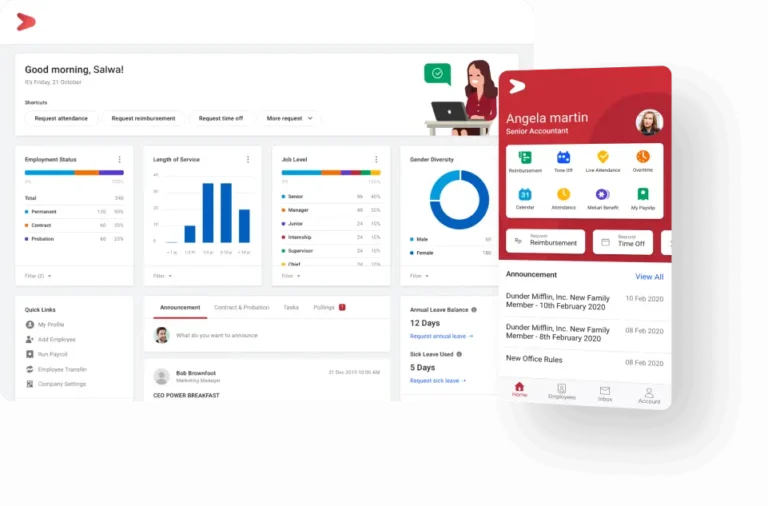
Mekari Talenta is known as a local HRIS vendor with a fairly easy implementation process.
It’s a solid choice for hotels that are just switching over from manual systems and don’t want to face a steep learning curve.
Some Mekari Talenta functions relevant to hotel operations include:
- Live Attendance with face recognition and geofencing
- Overtime
- Shift Schedule
- Payroll
- Employee Self-Service (ESS)
- Reporting
This software’s strength lies in its Live Attendance feature, validated through face recognition and geofencing, which reduces the potential for attendance fraud among front office and housekeeping staff across different points on the property.
Attendance data also connects directly to payroll, avoiding the risk of pay calculation errors.
Another added benefit comes from its connection to other Mekari products like Jurnal and Klikpajak, ideal for hotels that want their finance and tax matters handled within the same system.
Mekari Talenta offers three package tiers with different sets of advantages: Essential, Plus, and Talenta 360. For pricing details, you can reach out to Mekari Talenta’s sales team via WhatsApp.
Here’s a summary of Mekari Talenta’s pros and cons:
| Pros | Cons |
|---|---|
| Fairly complete, practical feature set for small-to-mid-size hotels | Cloud-only, no on-premise option yet |
| Attendance data connects automatically to payroll, reducing the risk of pay calculation errors | Subscription cost can rise significantly in the second year |
| Connects with other Mekari products (Jurnal, Klikpajak) for finance/tax needs | Fairly steep learning curve given the number of modules |
| No need to subscribe to other Mekari products to use this HRIS independently | Customization and system flexibility are still limited |
| Consistently kept up to date with the latest local labor regulations | Customer support runs on a ticketing system, not available 24/7 |
| Customer service team is fairly responsive and provides onboarding support | Falls short for large hotels that need strategic HR functions (workforce planning, advanced analytics) |
Mekari Talenta is a good fit for:
- Hotels migrating from manual/Excel-based records to a digital system for the first time
- Small-to-mid-size independent hotels without an in-house IT team
- Hotels already using other Mekari products (Jurnal, Klikpajak) for finance/tax needs
3. SunFish by DataOn

SunFish by DataOn is a local HR option built to enterprise standards, well suited for large hotel groups or multi-property chains that need corporate-grade data security and scalability.
SunFish features relevant to hospitality businesses include:
- Multi-country payroll
- BPJS
- PPh 21
- Learning Management System (LMS)
- Attendance
- Shift
- Recruitment
- Performance
- Employee Self-Service (ESS)
SunFish by DataOn’s main strength is its high scalability, making it relevant for hotel groups planning to expand across countries.
The system is also available in both cloud and on-premise modes, giving more flexibility in storing property data to whatever security standard is required.
SunFish by DataOn can also integrate with ERP systems or finance software the hotel is already using.
SunFish by DataOn’s official website doesn’t display pricing directly. You can contact and negotiate with their sales team to get pricing details that match your company’s needs.
Here’s a summary of SunFish by DataOn’s pros and cons:
| Pros | Cons |
|---|---|
| Available in cloud, private cloud, and on-premise options | HR teams need extra training before use, given how complex the features are |
| High scalability, suited for large hotel groups | Customization is still fairly limited |
| Easy integration with ERP systems and finance software | Fairly steep learning curve |
| Already holds ISO/IEC 27001 certification and SOC 2 Type 2 compliance reporting | Its enterprise-focused positioning makes it less of a fit for small lodgings |
| Payroll compliance with PPh 21, BPJS, and minimum wage holds up even across multiple countries | App performance risks slowing down when processing large data volumes at once |
| Comes with offline attendance support | Pricing is relatively high, and the features can feel like overkill for small businesses that just need a simple HR solution |
SunFish by DataOn is a good fit for:
- National or multinational hotel groups
- Hotels needing corporate-grade data security (ISO 27001, SOC 2 Type 2 certified)
- Hotel groups expanding into, or already operating properties in, Southeast Asia (Malaysia, the Philippines, Vietnam, Thailand)
4. HashMicro HRM
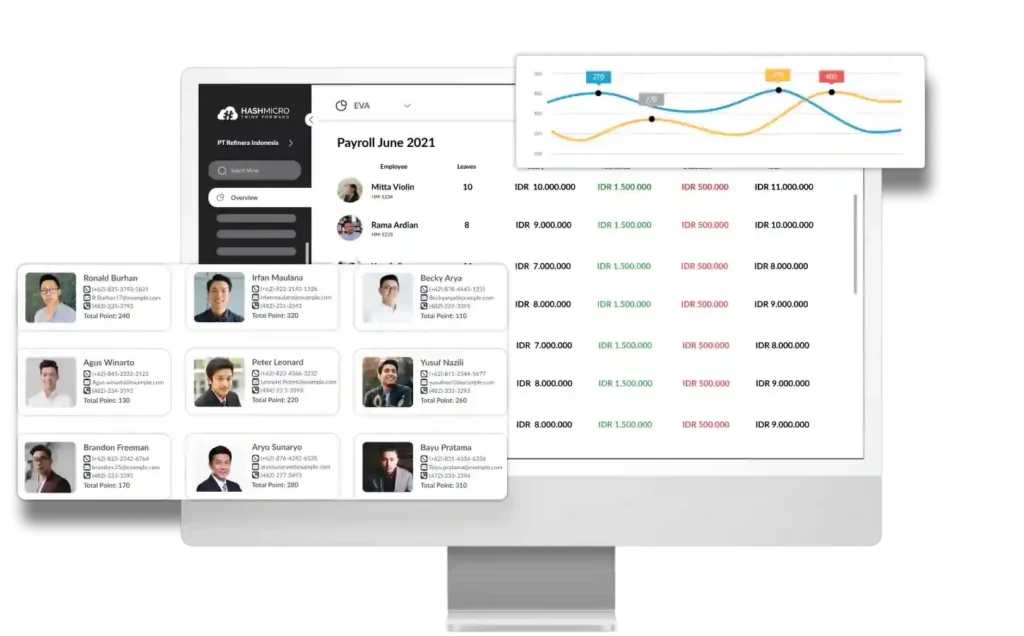
HashMicro HRM is a Human Resource Management module that’s part of HashMicro’s broader ERP ecosystem.
It’s a good fit for hotels that want every HR matter connected directly to other business processes like accounting, inventory, and purchasing.
Features available in HashMicro HRM include:
- Core HR
- Hashy AI (chatbot)
- Multi-currency & multi-branch payroll
- Attendance
- Shift scheduling
- Leave management
- Recruitment
- Performance management
- Employee Self-Service (ESS)
- HR Analytics
- ERP integration
HashMicro HRM’s main advantage is its high level of customization, allowing it to be tailored to each hotel’s workflow.
It also supports multi-currency and multi-branch payroll for hotel groups operating across countries.
There’s also an AI-powered chatbot feature (Hashy AI) that makes it easy for employees to submit leave requests, claims, and overtime.
HashMicro’s official website doesn’t openly display pricing for its HRM software. However, you can contact HashMicro’s sales team for a consultation on pricing.
Here’s a summary of HashMicro HRM’s pros and cons:
| Pros | Cons |
|---|---|
| Fully connected to the entire HashMicro ERP ecosystem | The HRM module is cloud-only; on-premise is only available with the full HashMicro ERP suite |
| Highly flexible customization tailored to each hotel’s needs | HRM performance isn’t optimal unless used alongside other ERP modules |
| The Hashy AI chatbot makes it easy to submit leave, claims, and overtime requests | Less cost-efficient if you only need the HRIS module |
| Supports multi-currency and multi-branch payroll schemes | Implementation takes longer than other vendors due to its complex feature set |
| An integrated ecosystem makes it easier to connect HR data with other business processes | Too complex for small hotels wanting a simpler solution |
| Priced as an annual package, worth comparing against other vendors’ per-employee pricing |
HashMicro HRM is a good fit for:
- Hotel groups that need ERP integration
- Multi-property hotels
5. Samta

Samta is the only vendor on this list built specifically around PMS (Property Management System) integration.
It isn’t a general HRIS customized for the hospitality industry — it was designed from the ground up for hotel operational needs.
Samta’s features include:
- PMS integration
- Channel manager
- Booking engine
- HRIS
- Accounting
Because everything sits within one unified ecosystem, employee data, shift schedules, and payroll in Samta’s HRIS module connect directly with reservation data and day-to-day hotel operations.
Its HRIS module covers an employee database, GPS- and face-recognition-based attendance, automated payroll with overtime calculation, and employee performance evaluation.
According to its official website, Samta offers several subscription tiers at different price points:
- Basic: Suited for homestays, boarding houses, small villas, and guesthouses (1–15 rooms), starting from Rp149,000/month.
- Standard: Suited for hotels, resorts, and serviced apartments (16–50 rooms), starting from Rp749,000 per employee/month.
- Enterprise: Suited for hotel chains, large resorts, and property groups (50+ rooms), with custom pricing based on specific needs.
Here’s a summary of Samta’s pros and cons:
| Pros | Cons |
|---|---|
| Purpose-built for hotel management needs, not a general HRIS adapted after the fact | Core HR features are still relatively untested, since HRIS plays a supporting role rather than being the product’s main focus |
| The only vendor on this list with native PMS integration, keeping HR data, shift schedules, and reservations in one ecosystem | The full HRIS module is only accessible from the Professional package up; properties on the basic plan don’t get HR features |
| Part of an all-in-one platform (PMS, channel manager, booking engine, accounting), so small hotels don’t need to subscribe to several systems at once | Its readiness for large, complex hotel organizational structures isn’t as strong as dedicated enterprise HRIS vendors |
| Entry-level pricing is affordable for small properties, and a 14-day free trial is available |
Samta is a good fit for:
- Boutique hotels, villas, and small-to-mid-size independent guesthouses
- Multi-property hotels wanting one all-in-one platform (PMS + HRIS + Accounting) instead of juggling several separate systems
- Hotels with no PMS yet that want to start fresh with a single ecosystem
6. KaryaOne

KaryaOne is HRIS software designed to handle the complexity of work shifts and overtime management.
Unlike full-featured HRIS platforms, KaryaOne is a better fit for hotels whose main pain points center on messy work schedules and overtime miscalculations.
KaryaOne’s standout features include:
- Shift Management
- Attendance with fingerprint scanner integration
- Payroll with automatic overtime calculation
KaryaOne’s strength lies in its integration with fingerprint scanners, making it a good fit for hotels that already have physical attendance hardware and just need to update the software side.
Its payroll module also supports PPh 21 and BPJS calculations, so users don’t need to worry about regulatory compliance risks.
KaryaOne doesn’t display specific pricing. For more details, you can contact KaryaOne’s sales team to get pricing that matches your company’s needs.
Here’s a summary of KaryaOne’s pros and cons:
| Pros | Cons |
|---|---|
| Connects directly with fingerprint scanners, ideal for lodgings that already have physical attendance hardware | UI design isn’t as modern as other HRIS vendors |
| Shift and overtime settings are flexible enough to follow dynamic hotel work patterns | Analytics dashboard is simpler than enterprise HRIS like LinovHR or SunFish |
| Simple interface means new staff don’t take long to train | Advanced features like AI analytics or talent succession planning are still limited compared to larger vendors |
| Payroll already supports PPh 21 and BPJS calculations | Less ideal in terms of scalability for hotels with very large, complex organizational structures |
| More affordable than enterprise-class HRIS, and a free trial is available |
KaryaOne is a good fit for:
- Hotels with highly complex shifts (housekeeping, security, 24-hour front office)
- Hotels that already have fingerprint attendance hardware and just want to upgrade the software
- Hotels that frequently run into employee overtime miscalculations
7. Gadjian

Gadjian is a local HRIS built to focus on digitizing the payroll process.
It makes a strong “starting point” for a small, single-property hotel beginning to digitize its HR processes.
Features available in Gadjian include:
- Flexible payroll
- Attendance
- Shift
- Leave
- Employee Self-Service (ESS)
Gadjian’s strength lies in its simple UI and UX, so HR teams at small hotels don’t need long to adapt.
Its payroll components can also be configured flexibly per employee, covering allowances, overtime, meal money, and PPh 21 and BPJS settings.
According to its official website, Gadjian offers several subscription tiers at different prices:
- Apresiasi Kinerja: Suited for companies just starting to digitize their systems, from Rp6,000 per employee/month
- Standar: Suited for small lodgings, from Rp12,500 per employee/month
- Sukses: Suited for mid-size to large hotels, from Rp20,000 per employee/month
Here’s a summary of Gadjian’s pros and cons:
| Pros | Cons |
|---|---|
| Simple UI/UX speeds up adaptation for small hotel HR teams | Cloud-only, no on-premise option |
| Payroll components can be configured flexibly per employee | Multi-property setup isn’t as flexible as other vendors’ |
| Transparent, flexible pricing (from Rp12,500–Rp20,000/employee/month) | Analytics is still limited to basic reporting, without strategic insight |
| Comes with an offline attendance mode for resorts with limited internet | Scalability isn’t well suited for large hotels; customization is also limited at enterprise scale |
| 14-day trial available |
Gadjian is a good fit for:
- Independent single-property hotels (not a chain)
- Small hotels or guesthouses just moving on from manual payroll records
- Budget-conscious properties that still need flexible, per-employee payroll
8. Gaji.id

Gaji.id is a local HRIS vendor focused on making payroll easy while staying compliant with Indonesian regulations.
It’s a good fit for small-to-mid-size hotels whose top priority is payroll accuracy and budget certainty.
Features offered by Gaji.id include:
- Complex daily payroll
- BPJS
- PPh 21
- Attendance
- Shift
- Recruitment
- Performance
- Employee Self-Service (ESS)
Gaji.id suits hotels running daily wage schemes, since many housekeeping or F&B staff are paid on a daily basis.
Another advantage of Gaji.id is flat pricing for the first three years with no increases, making it easier for small hotels to plan their long-term budget.
Gaji.id offers flexible pricing based on which features you use. For full details, you can consult directly with their sales team.
Here’s a summary of Gaji.id’s pros and cons:
| Pros | Cons |
|---|---|
| Payroll can handle a range of pay scenarios, including daily wage schemes | Currently cloud-only, no on-premise option |
| Responsive after-sales support | Features are still limited to basic HR needs like payroll and attendance |
| Flat pricing for the first 3 years, no increases | UI isn’t as modern as other vendors’ |
| Affordable rates, suited for small-to-mid-size hotels | Scalability doesn’t hold up well for large hotels |
| Offline attendance for areas with poor internet connectivity | Recruitment and performance management modules are still fairly weak and not yet fully all-in-one |
Gaji.id is a good fit for:
- Small-to-mid-size hotels with many daily/casual staff (especially housekeeping)
- Hotels prioritizing payroll accuracy and budget certainty (flat 3-year pricing)
- Hotels that don’t yet need in-depth recruitment or performance management modules
9. KantorKu HRIS
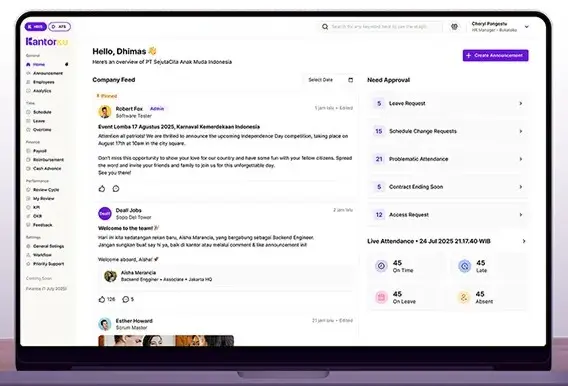
KantorKu HRIS is a local HRIS vendor offering a solid mobile experience, making it relevant for hotel operations with a large field workforce.
It’s one of the fastest and most affordable HRIS options to implement for lodging businesses just starting to digitize their HR systems.
KantorKu’s standout features include:
- Recruitment
- Attendance
- Payroll (PPh 21, BPJS, and bonuses)
- Performance (KPI/OKR)
- Employee Self-Service (ESS)
- Employee Database
- Analytics
Fast implementation is one of KantorKu’s key strengths, with system setup claimed to take only about three days.
Its tiered packages — Starter, Basic, Essential, up to Suite — also make it easy for small hotels to start with the cheapest plan and upgrade as headcount grows.
KantorKu HRIS pricing is quite affordable, starting from Rp4,900 per employee/month, making it a strong fit for small lodgings looking to start digitizing their systems.
Here’s a summary of KantorKu HRIS’s pros and cons:
| Pros | Cons |
|---|---|
| Fast implementation, taking only about 3 days until the system is ready to use | Cloud-only, no on-premise option |
| Core features (attendance, payroll, recruitment, performance) are combined in one system | HR features and report formats are fairly basic, not enough for more strategic analytics needs |
| Simple, mobile-friendly ESS interface | Limited scalability for large hotels |
| Fairly affordable, starting from Rp4,900/employee/month | More advanced features are only accessible through the top-tier Suite package |
| Already ISO 27001 certified | Still focused on the local market, less suited for multinational hotel groups |
KantorKu HRIS is a good fit for:
- Budget hotels and guesthouses just starting to digitize
- Small properties with a limited HR software budget
- Growing hotels that need a tiered system that scales with headcount
10. GreatDay HR
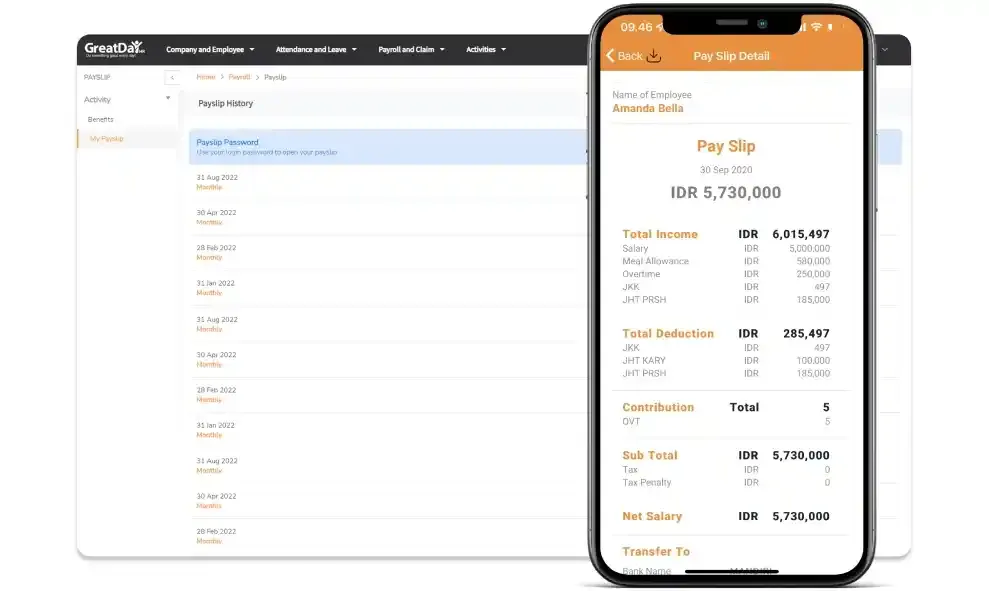
GreatDay HR is HRIS software that prioritizes attendance tracking and a strong mobile user experience.
Its mobile-friendly design makes it a good fit for hotels with many frontline staff who rarely use a computer or laptop.
Features offered by GreatDay HR include:
- Live Attendance
- Payroll
- Employee Database
- Employee Self-Service (ESS)
Its attendance feature includes face recognition and liveness detection, reducing the potential for attendance fraud among staff spread across different departments.
It also offers an Earned Wage Access (EWA) feature that lets employees withdraw part of their pay before the regular payday.
This is especially relevant for hotel staff, particularly at hotels running daily or weekly wage schemes.
GreatDay HR is priced from Rp25,000 per employee/month. Pricing may vary for further customization, so you’ll need to contact their sales team for adjusted pricing.
Here’s a summary of GreatDay HR’s pros and cons:
| Pros | Cons |
|---|---|
| Mobile-friendly, well suited for frontline staff across departments | Cloud-only, no on-premise option |
| Face recognition and liveness detection reduce the potential for attendance fraud | Attendance features rely heavily on internet connectivity |
| Earned Wage Access (EWA) lets employees withdraw pay ahead of the regular payday | Feature set is still limited to basic HR functions (payroll and attendance) |
| Flexible scalability, with packages that can be upgraded as the business grows | Desktop dashboard is fairly basic |
| Already ISO 9001:2015 and ISO 27001:2013 certified, ensuring data security | Falls short for large hotels with complex HR reporting needs |
GreatDay HR is a good fit for:
- Mid-size hotels wanting a clean mobile experience without enterprise-level system complexity
- Hotels where most frontline staff rarely access a computer or laptop
Which HRIS Software Fits Your Hospitality Business?
After learning about each vendor’s strengths, the table below can help you narrow down the right HRIS software for your hotel’s specific needs.
| Need | Recommended Software |
|---|---|
| Most flexible HRIS for complex hotel operations | LinovHR |
| Payroll with automatic service charge calculation | LinovHR and SunFish by DataOn |
| Easy-to-implement HRIS | Mekari Talenta and KantorKu |
| 24/7 shift management across departments (FO, HK, F&B, Engineering) | LinovHR and GreatDay HR |
| Hotels/resorts with multiple properties | LinovHR, SunFish by DataOn, and HashMicro HRM |
| Enterprise-scale hotel groups | LinovHR and SunFish by DataOn |
| Integration with hotel ERP/accounting systems | HashMicro HRM |
| Employee Self-Service (ESS) to improve the employee experience | LinovHR, Mekari Talenta, and Gadjian |
Features to Check When Choosing HRIS Software for Hospitality
Every hospitality business has different needs. Even so, there are a number of features worth prioritizing when evaluating HRIS software, especially for businesses managing multiple properties or departments with a large headcount.
Here are some aspects you can use as a reference during evaluation.
Multi-Department and Multi-Property Management
Hotels with multiple properties need a system that can group employee data by property or department (FO, HK, F&B, Engineering), manage the organizational structure at each location, and restrict access according to each person’s work area.
Ideally, the system should also be able to record employee transfers between properties without having to create a new record from scratch.
Shift Scheduling for 24/7 Operations
Since hotel operations almost never stop, an HRIS should be able to manage a range of shift patterns, from rotating shifts and split shifts to shifts that span across days.
Bulk scheduling and shift-swap features between employees speed up scheduling by department, with overtime automatically logged into payroll.
Mobile Attendance and Location Validation
Most hotel frontline employees work directly on the ground, which makes mobile-based attendance a crucial factor.
A combination of GPS attendance, geofencing, and face recognition helps confirm employees are genuinely at their work location when clocking in. Offline attendance capability also matters for resorts with unstable internet connectivity.
Payroll With Automatic Service Charge Calculation
Compensation schemes in the hospitality business tend to be more complex than in most other industries.
Ideally, the payroll system should be able to handle both daily and monthly wages, plus automatically calculate service charges in line with Permenaker 7/2016, along with allowances and overtime.
Compliance with BPJS and PPh 21, along with differences in regional minimum wage (UMK) across areas, is also essential for hotels with properties in multiple cities.
Integration With a PMS (Property Management System)
This feature is one of the defining characteristics that sets hospitality HRIS apart from HRIS in other industries.
With PMS integration, room occupancy data can inform staff scheduling needs, while aligning front office and housekeeping operational data with the HR system in real time.
Recruitment and Digital Onboarding
High frontline employee turnover means recruitment happens fairly often in the hotel business.
An Applicant Tracking System (ATS) and talent pool feature speed up candidate screening, while digital onboarding helps new employees get up to speed faster on hotel service and safety SOPs.
Performance Management by Department
To monitor team performance in each department, an HRIS should be able to generate reports on attendance, lateness, and turnover rates by work unit.
Performance management features with KPI, OKR, and Balanced Scorecard assessments can help supervisors evaluate front office, housekeeping, and F&B staff more objectively and measurably.
HR Analytics and Dashboard
A comprehensive HR analytics dashboard helps management see the state of the workforce in real time, covering headcount, turnover rate, attendance rate, and labor costs per property.
This kind of data matters for supporting strategic decision-making, especially heading into peak guest season.
Integration and Data Centralization
To integrate with other systems already in use, HRIS software should ideally have an open API and the ability to connect with attendance devices, PMS, ERP, accounting, and banking systems.
A single sign-on (SSO) feature can also make it easier for employees to access several company systems at once.
Scalability and System Performance
A growing hospitality business needs a system that can handle more employees and process payroll in bulk without a drop in performance.
A cloud-based system makes it easier to add new properties and support simultaneous access from many users across different locations.
Implementation and Customer Support
The quality of the implementation process also plays a big role in how successful an HRIS rollout ends up being. Make sure the vendor provides support during implementation, help with data migration, and training for both admins and end users.
Having a dedicated account manager and a clear customer support SLA also matters, especially for hotel groups rolling the system out across several properties at once.
Summary
| Feature Area | What to Check |
|---|---|
| Multi-property/department | Employee data grouped by department and property |
| Shift scheduling | Support for round-the-clock shift patterns |
| Attendance | Location-based validation, including offline mode |
| Payroll | Automated service charge calculation |
| PMS integration | System readiness to connect with a PMS |
| Recruitment | Completeness of recruitment and digital onboarding |
| Reporting | Performance reports broken down by department |
| Analytics | Real-time HR analytics dashboard |
| Integration | Open API for connecting with other systems |
| Scalability | Capacity to grow with more properties and employees |
| Support | Quality of implementation support and customer service |
Question Checklist for Your HRIS Software Demo
Before committing to any HRIS system, take the time to sit through a live demo with the vendor. The following questions can help you make a more informed decision:
- Does the software support multiple hotel properties/branches?
- Can payroll calculate service charges in line with Permenaker 7/2016 (equal distribution plus seniority/performance weighting)?
- Can the system integrate with the PMS the hotel already uses?
- Does the attendance feature still work when the internet connection is unstable?
- Is geofencing available?
- Can reports be broken down by department?
- How long does implementation take?
- Are there additional costs for training and integration?
Manage Hospitality HR Operations With LinovHR’s Integrated Platform
Managing HR in the hospitality industry comes with challenges at every stage, from frontline employees across departments and constantly shifting schedules to payroll with service charge components.
Ideally, tackling all of this means administrative processes shouldn’t be handled manually anymore.
The right HRIS software is one of the most effective ways to solve these problems while keeping operations efficient amid the complexity of a multi-department, multi-property hospitality business.
LinovHR is HRIS software for hospitality businesses that supports end-to-end HR management, from recruitment and GPS/geofencing-based attendance to automated payroll with service charge calculation and performance management.
All of this can happen on a single platform that can be tailored to your business workflow.
Make LinovHR your hospitality HRIS of choice so your HR team and hotel operations can run more efficiently across every property and department.
Schedule a LinovHR demo today to see firsthand how the platform can be tailored to your hospitality business needs.
Frequently Asked Questions (FAQ)
What’s the main difference between HRIS software for hotels and general-industry HRIS?
HRIS software for hospitality businesses is purpose-built around the dynamics of the hospitality industry. The difference shows up most in its ability to manage complex shifts across departments (front office, housekeeping, F&B, engineering), multi-property management features, easy PMS integration, and a payroll module that can calculate service charges in line with Indonesian labor regulations.
How does HRIS software calculate service charges in line with Indonesian regulations?
Under Manpower Regulation No. 7/2016 (Permenaker 7/2016), the service money collected from hotel and restaurant customers is distributed to employees using a formula that typically combines an equal share with weighting for seniority or performance. HRIS software that supports this feature can automatically calculate and distribute the service charge in every payroll period, cutting down the risk of manual calculation errors.
Can hotel HRIS software prevent staff attendance fraud?
Yes. Most good hospitality HRIS software today comes equipped with location-based mobile attendance features. Through a combination of GPS tracking, geofencing, and face recognition, the system validates attendance so employees can only clock in when they’re genuinely within the hotel property’s set radius.
Can hotel HRIS be integrated with a PMS system?
Yes. Some vendors, like Samta, even offer native PMS integration since they’re built specifically for the hospitality industry. Meanwhile, for end-to-end HRIS software like LinovHR, SunFish, or HashMicro HRM, the connection to a PMS or other third-party software is usually bridged through an API, aligning attendance data, shift schedules, and staffing needs with room occupancy rates.
How does HRIS help hotels reduce high employee turnover?
HRIS helps streamline the entire employee journey, from start to finish. Systematic digital onboarding, transparent calculations for pay, overtime, and service charge, plus easy Employee Self-Service for requesting leave, all make for a better employee experience. On the management side, HR Analytics features let HR teams monitor attendance trends and workload by department, so potential staff burnout can be caught earlier, before it leads to a resignation.