Construction and heavy equipment businesses depend heavily on precise workforce management. A single project can involve permanent employees, contract workers, heavy equipment operators, technicians, field supervisors, mechanics, and day laborers. Each person may work at a different site, under a different schedule, with a different risk level, certification, and payment scheme.
Problems start when a company still manages HR data through spreadsheets, manual reports, or disconnected systems. HR struggles to see who is actually present at a given project. Project managers find it hard to confirm whether workers hold valid, current certifications. Payroll teams end up validating attendance, overtime, project allowances, and wage components by hand.
These conditions make HRIS a strategic necessity for construction and heavy equipment businesses. An HRIS helps a company manage employee data, attendance, payroll, competency, training, and performance within a single system. With the right system in place, a company can improve operational efficiency without losing control over the people working out in the field.
Key Takeaways
-
- Construction and heavy equipment businesses often run multiple projects at once, which makes accurate workforce management essential. Every worker can be assigned to a different location, with a different schedule, risk level, certification, and payment scheme.
-
- HR management in this sector faces a wide range of challenges, including supply chain disruptions, workforce unpreparedness, skill gaps, limited HR capacity across multiple projects, disconnected employee data, unsystematic recruitment, and workplace accident risk.
-
- An HRIS solves many of these management problems by delivering real-time visibility, reducing payroll errors, speeding up workforce distribution, keeping certifications and safety training on track, and supporting data-driven management decisions.
-
- HRIS implementation costs depend on headcount, module selection, integration needs, customization, data migration, and the implementation model. ROI can be measured by looking at time saved on administration, fewer payroll errors, better overtime control, and more efficient workforce distribution.
HR Management Challenges in Construction and Heavy Equipment Businesses
HR management in construction and heavy equipment businesses looks very different from other industries. Employees rarely work from a head office. Many workers move from one project to the next, and some need special certification before they can enter high-risk work areas.
The KPMG Global Construction Survey 2025/2026 found that 76% of construction executives rank workforce as a strategic priority, reflecting how much these leaders value operational transformation to keep company growth on track.
People are one of the biggest assets a construction or heavy equipment business owns. Unfortunately, many companies still lack enough skilled talent, particularly in technology and data roles, and that shortage has become a genuine challenge for the sector.
That challenge shows up in the numbers too. 55% of survey respondents named the scarcity of skilled labor and gaps in managerial and technical competency as one of their biggest hurdles.
To address this, the same report found that 82% of respondents plan to increase their investment in employee training and development, aiming to hit their strategic priorities and keep growth sustainable.
Here are several other HR management challenges that show up in construction and heavy equipment businesses.
1. Supply Chain Disruptions Hold Back Productivity and Workforce Planning
Construction projects and heavy equipment operations depend heavily on the availability of materials, fuel, spare parts, tools, and smooth distribution to the work site. Supply delays can hold up scheduled work stages and disrupt how the workforce is deployed on site.
This often leads to project delays, which then affect productivity, quality, timelines, and cost. Project delays are a common issue in developing countries.
A PLOS One journal article titled “Causes of delays in construction projects in the Province of Aceh, Indonesia” by Anita Rauzana and Wira Dharma identifies project delays as a major cause of construction project losses, with delays recorded at 80%.
The study examined project delays across Aceh using a questionnaire distributed to 68 contractor companies, with the resulting data tested for validity and reliability.
The research pointed to several causes behind these delays, including changes in material form, function, and specification, materials damaged in storage, ordering mistakes, late material arrivals, inefficient material use, and poor calculation of material needs.
This shows that supply chain problems rank among the leading factors behind construction delays. Poor supply chain management can stall a project’s progress, which ultimately creates waste and pushes timelines back even further.
2. Workforce Unpreparedness for Complex Projects
Construction and heavy equipment businesses need workers who are ready to operate across different locations, field conditions, and project phases. The challenge shows up in competency readiness, work discipline, safety awareness, technical ability, and adaptation to modern project technology.
A heavy equipment operator, for example, needs more than the ability to run the machine. They also need to understand safety standards, equipment monitoring technology, field work procedures, and how to coordinate with the project team.
Without workforce readiness data, HR struggles to answer important questions like these:
- Which workers are ready for a new project assignment?
- Who needs refresher training?
- Whose certifications are about to expire?
- Does the project already have enough people on the ground?
Without clear answers, a company risks running into workforce deployment problems and falling project productivity.
3. Skill Gaps and Poor Projection of Future Workforce Needs
Advances in construction technology, fleet management, automation, and modern heavy equipment all demand new skills. Yet many companies still lack a structured plan for building those competencies.
KPMG’s report notes that many construction workers still lack strong command of digital tools and modern construction technology. The report also points to poor company projection of future skill needs as one reason behind this skill gap.
This problem has a direct impact on workforce planning. A company might win a new project and then find it does not have operators, technicians, or supervisors with the skills to run it.
This is where HR steps in to build sound workforce planning. HR needs to know which skills exist today, which skills the business will need next, and which gaps need to be closed through recruitment or training.
4. Limited HR Capacity to Manage Multiple Projects at Once
Construction and heavy equipment businesses often operate across multiple projects at the same time. A single company might manage several projects that differ in location, duration, workforce needs, and risk level.
A 2025 SA Journal of Human Resource Management article titled “Exceeding expectations: A study on human resource management implementation in construction organisations” describes construction companies as inherently multi-project environments.
Projects can run simultaneously, sit in different locations, and move through different work stages, which makes workforce distribution a central challenge for both project managers and HR.
Project managers already carry heavy responsibility for the success of each separate project. On top of that, they need to coordinate workforce distribution and manage how those projects connect to one another.
When workforce data is not integrated, HR loses visibility into how workers are distributed. One project can end up short-staffed while another sits with more workers than it actually needs.
5. Employee, Attendance, Certification, and Payroll Data Living in Silos
Many HR management problems in construction start with scattered data. Employee data sits in a spreadsheet, attendance data lives in each project supervisor’s own report, certification data sits in a separate folder, and payroll gets calculated by hand.
Working this way raises the risk of error. HR has to reconcile data from many sources before payroll can even run, and project managers lack real-time visibility into attendance, overtime, and worker certification status.
On top of that, construction and heavy equipment businesses usually run projects across many different locations, and individual workers can rotate between specific projects over time.
Interviews with LinovHR’s internal teams surfaced one challenge faced by LinovHR client Bauer Pratama Indonesia: attendance, an aspect that is central to accurately recording worker presence. A worker might start on Project A, then get moved to Project B a week later, and that kind of mobility only adds to the complexity.
Companies also face a real challenge in keeping attendance records accurate and aligned with what is actually happening on site.
Integrated data helps a company make decisions faster. From one central system, a company can see active workers, work locations, overtime hours, certification validity, and labor costs all at once.
6. Recruitment and Selection That Still Lacks Structure
Recruitment in construction and heavy equipment businesses has to check far more boxes than in most other industries. HR needs to review project experience, technical skills, certifications, field work ability, and how well a candidate fits safety standards.
A Journal of Applied Engineering Science article titled “Human Resource Management Patterns In Indonesia’s Construction Companies” by Susilowati and colleagues found that HR planning patterns at Indonesian construction companies still focus mainly on short-term, operational planning, with selection process analysis serving as one indicator of that pattern.
The study backs this up. Operational HR planning scored highest among construction companies, with an average score of 3,4, placing it in the excellent category.
Strategic planning (long-term) and tactical planning (medium-term) scored an average of 3,2 and 3,1 respectively, both falling into the good category.
The same study found that analyzing the need for additional HR staff scored lowest among all HR planning indicators, at 2,7. That suggests awareness of internal staffing limitations is still fairly low. When workloads spike as a result, many companies simply lean on overtime policy to cover the shortfall.
When planning for additional HR needs is not systematic, a company risks hiring workers who fall short of the required qualifications. The impact often surfaces once the project is already underway, forcing the company into extra training and often leading to lower productivity or higher safety risk.
7. Project Worker Compensation and Payroll Problems
Payroll for project workers is far more complex than payroll for office staff. A company has to calculate fixed wages, daily wages, overtime, location allowances, project incentives, deductions, taxes, BPJS contributions, and other components.
Problems surface when attendance, overtime, and payroll data are not integrated. Employees can end up with delayed payments, and the company can end up with inaccurate calculations.
On projects spread across many locations, manual validation eats up a lot of time, since HR and finance teams have to double-check data from every site before payroll can be processed.
8. Accident Risk from Fatigue, Workload, and Weak Safety Controls
According to OSHA (the Occupational Safety and Health Administration), as cited in a journal article titled “Determinants of Workplace Accidents among Heavy Equipment Operators: A Cross-Sectional Study in Indonesia” by Revalita and colleagues, fatigue is a condition that lowers alertness, slows reaction time, and raises the likelihood of human error.
That research links work fatigue directly to workplace accidents, particularly among heavy equipment operators. Fatigue can reduce concentration, slow response time, and raise the risk of mistakes while operating heavy machinery.
As a result, operators become more prone to accidents such as falls, collisions, or losing control of their equipment. Insufficient rest also has a direct effect on physical and mental condition, which raises the risk of both accidents and equipment damage.
Beyond fatigue, a journal article titled “Analysis of Fatal Construction Accidents in Indonesia, A Case Study” by Bria and colleagues found that the largest share of accidents involved collisions with construction machinery, accounting for 62 of 133 cases, or 46%, followed by workers struck by falling or flying objects.
This connects closely to negligence and noncompliance with safety standards. In construction and heavy equipment businesses, stronger compliance with regulations and a better understanding of vehicle operating standards both play an important role in bringing accident numbers down.
Working-hour policy and company practices that account for fatigue matter just as much when it comes to minimizing workplace accidents.
9. Training Programs Without Clear Objectives
Training at construction and heavy equipment companies often exists only to meet short-term operational needs. In reality, training should focus on closing competency gaps, addressing project risk, meeting safety standards, and supporting workers’ career needs.
The ILO (2015) names construction as one of the most dangerous sectors to work in. At least 108,000 workers die on the job every year, representing roughly 30% of all fatal work injuries worldwide. The ILO also notes that the causes behind accidents and occupational illness in this sector are generally preventable.
That data makes clear that safety training cannot be treated as a mere formality. Companies need to make sure workers genuinely understand job risks, proper use of personal protective equipment, heavy equipment procedures, and safe work standards.
10. Ineffective Performance Appraisal for Project Workers
Performance appraisal for project workers is often far from objective. Many companies still base it on informal observation from field supervisors.
This approach makes it hard for a company to decide who deserves an incentive, a promotion, a rotation, or further training, and it makes it just as hard for HR to connect individual performance with actual project outcomes.
The SA Journal of Human Resource Management found that the construction companies it studied had not meaningfully implemented performance appraisal best practices, a result of using the wrong evaluation methods and failing to properly recognize good work.
That gap tends to spill into other problems too, including lower morale, weaker retention, and less engaged project teams. Project managers need to find a constructive way to run performance appraisals so teamwork stays focused on finishing the project on time.
11. Worker Data Documentation Without Structure
Project locations that are spread out and running at the same time make it hard to keep worker documentation and placement data properly organized. This makes it difficult for a company to map out workforce availability and needs across every project.
Interviews with LinovHR’s internal teams revealed that clients such as Bauer Pratama Indonesia and Aneka Jaringan Indonesia have run into situations where a worker gets called up for a specific project assignment, even though that worker had already been moved to a different project.
That kind of mismatch leaves a worker’s history data less accurate and forces the company to go back and correct location and assignment status records.
The challenge grows more complex when project managers handle worker contracts directly instead of routing them through HR. In that setup, contract start and end dates end up depending on each individual project manager.
Without placement, contract, and worker history data managed in one central system, a company will struggle to get accurate workforce information. That gap can slow down worker allocation and put smooth project operations at risk.
HRIS Capabilities That Address the Complexity of Construction and Heavy Equipment Businesses
The right construction HRIS software does more than store employee data. It needs to help HR, project managers, and leadership see the true state of the workforce with real accuracy.
An HRIS also needs to support field realities. In other words, the system has to keep up with project work that shifts location, involves many different worker statuses, and demands fast data validation.
1. Managing Multi-Project and Multi-Location Workforces
An HRIS helps a company manage workers by project, location, site, workshop, or branch. HR can see who is working on a given project, who is available, and who has already been assigned elsewhere.
This capability matters for companies running several projects at once. With centralized data, HR can cut the risk of misallocating the workforce.
Project managers also get a clearer picture of their manpower needs. When a project needs an extra technician or operator, HR can search for internal candidates based on availability and competency.
2. Integrating Employee, Attendance, Certification, and Payroll Data
An HRIS connects employee data with attendance, overtime, certification, contracts, and payroll. This integration helps a company cut down on manual validation work.
For example, a field worker’s attendance data gets recorded automatically, while approved overtime feeds straight into payroll calculations. Certification data, meanwhile, helps HR confirm that workers flagged in the competency gap list have already received the right training.
This integration brings real benefit to companies with large project workforces. HR no longer has to pull data together from a stack of separate documents before running payroll.
3. Mapping Skills, Certifications, and Workforce Readiness
Construction and heavy equipment businesses rely heavily on structured skill data. HR in this industry needs to know exactly who can operate heavy equipment, who has specific project experience, who holds valid safety certification, and who has mastered other relevant technical skills.
An HRIS helps a company build a clean, organized skills database. That centralized data makes it easy for HR to track:
- The skills each worker holds
- Which certifications are still active and which are about to expire
- Whether a worker is ready for immediate field placement
- Which workers need additional training
This kind of structured mapping lets a company put together far more solid workforce planning before a project even begins.
4. Managing Training and Performance Evaluation for Project Workers
An HRIS helps HR design a training plan around actual competency needs, whether that means safety, heavy equipment operation, construction technique, leadership, field communication, or project risk identification.
The system can also keep a full training history, so HR can see who has completed which training, how they scored, and what development they need next.
On the performance management side, an HRIS helps a company build KPIs that are genuinely measurable, with results that feed directly into decisions on promotion, rotation, compensation, and further training.
5. Delivering Real-Time Workforce Visibility
Construction companies need fast visibility into their workforce. HR and management need to see active headcount, attendance levels, overtime, open positions, and where extra staff is needed, all without delay.
An HRIS analytics dashboard helps management catch problems early, before they grow into something bigger. That data matters for controlling labor costs and reducing the risk of project delays.
With real-time visibility, HR can act faster. HR might immediately follow up on high absenteeism at a specific project, for instance, or spot recruitment needs before a project runs short on workers.
Operational Benefits of Using HRIS
An HRIS delivers direct benefits to daily operations. Its impact shows up in everyday HR work, project coordination, payroll, training, and decision making.
Here are the benefits construction and heavy equipment businesses commonly experience from using an HRIS.
1. Real-Time Visibility Into the Workforce on Every Project
An HRIS helps management see workforce conditions on every project. A company can tell who is present, who is absent, who is working overtime, and which positions still sit open.
This data helps project managers make operational decisions without waiting around for a manual report from the field.
2. Fewer Attendance, Overtime, and Payroll Errors
Integrating attendance with payroll helps a company cut down on wage calculation errors. Attendance, overtime, project allowances, and deductions can all be processed in a structured way.
This matters because late or incorrect pay erodes worker trust. On projects already under time pressure, payroll problems can easily disrupt team motivation and stability.
3. Faster Worker Distribution to Match Project Needs
An HRIS helps HR select workers based on competency, experience, certification, and availability, which makes worker distribution both faster and more precise.
When a project needs an operator with a specific certification, for example, HR can simply pull that data from the system instead of checking documents one by one.
4. Keeping Certifications and Safety Training Under Control
A company can use an HRIS to track certification validity, and the system helps HR flag which workers need to renew theirs.
This matters most for high-risk work. A company needs to confirm that workers have completed the relevant training before they ever step into a project area.
5. Supporting Data-Driven Management Decisions
An HR analytics dashboard helps management track turnover trends, attendance, labor costs, recruitment needs, training effectiveness, and productivity.
This data makes management decisions more objective. A company can pinpoint exactly when it needs to hire, when it needs to run training, and when it needs to rethink its workforce placement strategy.
How to Choose the Right HRIS for a Construction and Heavy Equipment Business
Every HRIS comes with a different feature set, and construction work naturally spans many project locations, a wide variety of work schedules, and a fairly complex payroll setup.
That is why a construction company needs to choose a system that fits its actual project work patterns and field needs, so HR management can run smoothly without hitting obstacles that eat into cost efficiency.
Here are the criteria worth using when you evaluate your options.
1. Choose an HRIS That Supports Multi-Project and Multi-Location Management
Make sure the HRIS can organize employee data by project, work location, site, branch, workshop, or equipment operating area. This feature matters because workers move between project locations, so HR needs a clear, current view of every worker’s placement status.
2. Confirm the HRIS Offers Mobile Attendance for Field Workers
Field workers need an attendance system they can use outside the office. Look for an HRIS that supports mobile attendance, geotagging, approval workflows, and real-time data. A mobile attendance feature gives HR presence data from every project location without waiting on a manual report, and that same data can feed directly into overtime and payroll calculations.
3. Choose an HRIS That Supports Offline Attendance in Low-Signal Areas
Construction projects often sit in areas with poor signal, such as mining sites, plantations, remote regions, or project locations far from any city. That becomes a real problem when an attendance system only works while the device stays connected to the internet.
Look for an HRIS that offers an offline attendance feature. It lets workers clock in and out even when signal is hard to find. Attendance data stays saved temporarily on the device, then syncs automatically the moment it reconnects to the internet.
Also look for an attendance correction feature. That way, once a worker gets home the next day and has proper signal again, they can go back and correct their clock-in and clock-out times.
A device-based attendance feature is worth considering too. This setup relies on a single tablet at each project site for workers to check in on, with attendance data flowing straight from that tablet into the HRIS.
4. Check How Well the HRIS Integrates Attendance, Overtime, and Payroll
The right HRIS needs to connect attendance data, overtime, project allowances, and every payroll component. That integration cuts down manual work and lets HR process payroll with data that is already prepared and far easier to audit.
In construction and heavy equipment businesses, workers are usually paid by the day and by project, so a well-structured attendance system is essential for handling requests like leave, permission, and overtime. That structure supports far more accurate payroll calculation.
5. Prioritize an HRIS With Strong Competency and Training Management
Construction and heavy equipment businesses depend on certified workers, so the HRIS needs to support competency mapping, training, and certification validity tracking. This feature helps a company keep its workforce genuinely ready, and it lets HR design training around whatever gaps the system detects.
6. Choose an HRIS With Strong Dashboard Analytics
A dashboard gives a company visibility into labor cost, manpower needs, turnover risk, attendance, overtime, productivity, and certification status. With that dashboard in place, management can spot problems early instead of watching them grow, and decisions can finally rest on real, already-gathered data rather than a manual report that arrives too late.
7. Make Sure the HRIS Supports Data Migration and System Security
Companies still relying on spreadsheets often have employee data scattered across several documents, covering everything from personnel information and placement location to work contracts, attendance, payroll, competency, and certification validity.
When moving data from spreadsheets into a new system, a company first needs to confirm that the data is complete and accurately reflects worker conditions at every project location.
A company also needs to look closely at the security the HRIS actually offers, since the system holds sensitive information such as worker identity, contract data, attendance history, payroll details, and personnel documents.
Confirm that the HRIS offers role-based access control too. A project manager, for instance, should only be able to access worker data for the project they actually oversee, which keeps every piece of HR data in the system secure.
8. Consider the HRIS Implementation Timeline and Rollout Stages
Implementation timelines vary from one company to the next, shaped by headcount, the number of project locations, which modules get used, how much data integration is needed, the level of customization, and how ready the internal team actually is.
As a general benchmark, a cloud HCM rollout for a mid-sized company can take roughly four to six months. That figure is not a fixed standard for every company; it simply offers a sense of scale for anyone about to adopt an HRIS.
For construction and heavy equipment businesses, implementation can get more complex since it involves pulling together worker data from many project locations. The implementation team also has to account for a wide range of worker statuses, work patterns, field attendance setups, placement locations, and more.
Before choosing an HRIS provider, make sure the implementation timeline spells out every stage, the data required, what the internal team is responsible for, the testing process, and the support available once the system goes live.
Estimated Cost and ROI of HRIS Implementation for Construction and Heavy Equipment Businesses
There is no fixed price tag for implementing an HRIS. Every company’s needs differ depending on how complex its HR management really is.
At LinovHR, implementation cost gets tailored to headcount and the modules a company chooses, so a business can select its HRIS based on its actual needs, its growth trajectory, and the work systems it wants to manage.
Factors That Affect HRIS Investment Cost
A number of factors shape HRIS investment cost, including:
- Number of employees to manage
- Number of modules in use
- Number of projects, sites, branches, or work locations
- System customization needs
- How complex the work schedule and payroll setup is
- Integration needs with ERP or other systems
- The volume and condition of data being migrated
- Support systems needed for attendance flexibility
- Whether the implementation model is cloud or on-premise
- Implementation services, training, and post-launch support
In construction and heavy equipment businesses, cost planning also needs to account for managing workers across multiple projects. Companies typically need to manage data covering work location, placement status, schedules, overtime, project allowances, and payroll, and those needs often look different from one project to the next.
These considerations deserve a real place in the overall investment cost calculation for HRIS adoption.
How to Measure HRIS ROI and Implementation Success
Measuring HRIS ROI goes beyond administrative cost reduction alone. A company can also measure its impact on time saved, fewer payroll errors, tighter overtime control, and more efficient use of the workforce.
Several indicators can serve as HRIS ROI measures, including:
- Less time spent compiling attendance data from each project
- Less time spent validating overtime and payroll
- Fewer payroll corrections
- Less reliance on manual documents and spreadsheets
- Fewer administrative hours for the HR team
- Less unplanned overtime
- Lower risk of placing workers on the wrong project
- Faster workforce distribution
- Less time spent searching for competency and certification data
- Avoided costs from late certification renewals
To measure the ROI an HRIS delivers, a company can use the following formula.
ROI formula = (Net benefit − Total investment cost) ÷ Total investment cost × 100%
Example:
A company spends Rp300 million on HRIS investment in the first year. After implementation, the company calculates savings from administrative time, fewer payroll corrections, better overtime control, and improved operational efficiency worth Rp420 million.
The calculation works out as follows:
ROI = (Rp420 million − Rp300 million) ÷ Rp300 million × 100%
ROI = 40%
That result means every Rp1 invested generated a net return of Rp0,40.
This figure is only meant as an illustration. A company should run its own measurement before and after adopting an HRIS to see the real, concrete impact on its operational efficiency.
Top HRIS Software for Construction and Heavy Equipment Companies
Here are several HRIS and HCM software options worth considering for construction and heavy equipment businesses. Any final choice still needs to match company scale, project complexity, payroll needs, integration requirements, and implementation readiness.
1. LinovHR

LinovHR suits companies that want an HRIS built around fully integrated modules. The software offers an HRIS solution that helps simplify and optimize nearly every aspect of HR management.
With LinovHR in place, HR administration becomes both more efficient and more strategic, freeing up the HR team to focus on employee development and business growth.
LinovHR’s talent management suite covers Recruitment, Performance Management, Competency, Learning Management System, Career Path, and Succession Management.
For construction and heavy equipment businesses specifically, modules such as Time Management, Payroll, Recruitment, Competency Management, Learning Management, and Performance Management help HR manage project workers far more systematically.
LinovHR also works well for companies that want to roll out an HRIS in stages, starting with the most urgent need, whether that is attendance, payroll, or recruitment, then adding modules over time as needs grow.
The software also offers a high degree of flexibility, with both cloud and on-premise options available.
With the cloud system, a company can put ready-to-use modules to work right away, paid for through a subscription that scales with its needs.
The on-premise system, meanwhile, gives a company full control over its HR technology by running it on its own servers, with complete freedom to customize the system as needed.
2. SAP SuccessFactors

SAP SuccessFactors HCM offers a cloud HCM solution covering core HR and payroll, talent management, HR analytics, workforce planning, and employee experience management. SAP states that more than 10,000 customers across over 200 countries and territories already use the platform.
SAP SuccessFactors is worth considering for large companies that need an enterprise-scale HCM system, particularly those with global operations, complex structures, and cross-functional integration needs.
3. Oracle Fusion Cloud HCM

Oracle Fusion Cloud HCM is a cloud solution that brings HR processes together under one data model and user experience. Oracle describes the system as a way to connect HR processes with every person across the organization.
The software fits large companies that need HR tightly integrated with other management processes, supporting needs across HR, talent, workforce management, and payroll.
4. Workday Human Capital Management

Workday Human Capital Management offers an HR suite covering planning, analytics, and talent management, positioning its HCM as a connected, flexible HR solution for workforce management.
Workday suits companies that need workforce analytics and talent management at scale, and it works best for organizations already prepared for a cloud HCM rollout.
5. Zoho People
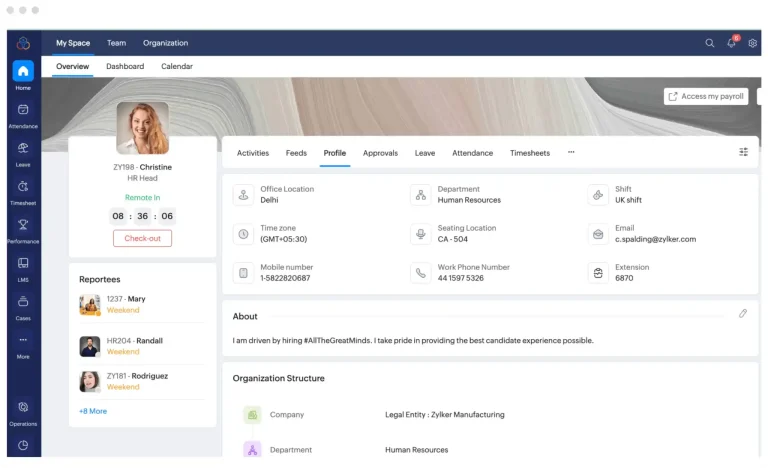
Zoho People is a cloud-based HR software covering onboarding, time and attendance, performance, learning management, an HR help desk, document management, employee engagement, and reporting.
Zoho People can work for companies that want cloud HR software with basic to intermediate features, though it is still worth checking whether those features truly match your project, payroll, and field operation needs.
How LinovHR Solves HR Challenges for Construction and Heavy Equipment Companies
LinovHR helps construction and heavy equipment companies run HR through a far more integrated system, with each module built to solve the operational problems that keep showing up in the field.
1. Time Management

Time Management helps a company manage worker attendance, schedules, and overtime, making it especially useful for field workers spread across many sites.
Whenever requests come in for leave, permission, or overtime, the company can track employee attendance in real time without any hassle.
Attendance data then becomes the foundation for validating productivity and payroll, and HR can cut out the manual recap work that used to come from every single project location.
LinovHR also includes attendance features such as offline attendance, attendance correction, and Linov Portal. All three help workers log their attendance even when signal at the project site is limited.
Offline attendance lets a worker clock in and out even with poor signal around the project site. The attendance data saves temporarily on the device and syncs automatically once it picks up a connection again.
Attendance correction, meanwhile, lets workers fix their clock-in and clock-out times once their device reconnects to the internet.
LinovHR also offers Linov Portal, a device or tablet-based attendance system. A tablet sits at each project location for workers to log attendance on, and that data then flows straight into the LinovHR HRIS.
With these features in place, the risk of attendance recording errors drops significantly, since workers can still log their attendance even where signal at the project site is minimal.
2. Payroll

LinovHR’s Payroll module helps a company manage every pay component, including base salary, overtime, leave, allowances, tax, BPJS, and more.
Every payroll calculation runs automatically and already accounts for requests such as overtime, leave, and permission.
For construction businesses, payroll integrated with attendance helps cut the risk of underpayment, delayed payment, and wage calculation errors.
3. Personal Administration

LinovHR’s Personal Administration module helps the HR team manage personnel information from one central place, storing and updating employee data in a single system so important information stays easy to access and manage.
This capability suits construction and heavy equipment businesses that often run several projects at once across different locations. The HR team can track work location details, employment status, and which employees are allocated to each project in a far more structured way.
Once a project wraps up, the company can also update each worker’s status and decide on next steps, whether that means standing by at home, in a dormitory, or at the workshop, moving to another project, changing employment status, or adjusting workforce allocation.
With centralized data, worker mapping and distribution can follow a much clearer path, guided by the workforce planning the company has already set.
4. Recruitment

LinovHR’s Recruitment module helps the HR team run a far more structured recruitment process, covering candidate pipeline management, selection stages, approvals, and recruitment documentation all in one system.
This module fits construction and heavy equipment businesses that regularly need extra workers to match project demand. When internal headcount cannot cover manpower needs at a particular location, for instance, the company needs to bring in additional workers so the project stays on track.
Through LinovHR’s Recruitment module, the HR team can manage hiring based on position needs, work experience, certification, competency, and a candidate’s placement location, using scoring and filter features to screen candidates against criteria the company has already defined.
A more systematic selection process helps the HR team lower the risk of hiring workers who fall short of a project’s technical needs or qualifications.
5. Competency Management

Competency Management helps a company map out worker skills, which matters for heavy equipment operators, technicians, mechanics, supervisors, and other roles that call for specialized competency.
With competency data on hand, HR can see exactly who is ready for a given project and identify the skill gaps that still need closing through training.
6. Learning Management

LinovHR’s Learning Management module helps HR manage training schedules, training history, certification, evaluation, and skill development needs.
This module makes it easier for a company to run blended learning programs, and employees can access training materials easily through either the website or a mobile device.
This service matters a great deal, since it helps construction and heavy equipment businesses run training on safety, heavy equipment operation, construction technique, leadership, and other competencies that support project performance.
7. Performance Management

Performance Management helps a company build KPIs, deliver feedback, and evaluate worker performance far more objectively.
Appraisal results can then support decisions on promotion, compensation, rotation, and further training. With a more measurable process in place, a company can manage project worker performance in a way that feels genuinely fair and transparent.
Start transforming your HR system for your construction and heavy equipment business with LinovHR. Request a free demo and discover how to manage your workforce, shift schedules, attendance, overtime, payroll, safety training, and employee development in one efficient, integrated system.
Frequently Asked Questions (FAQ)
1. When should a construction company start using an HRIS?
A company should consider an HRIS once headcount, project locations, and administrative processes start getting genuinely complex. An HRIS also becomes necessary the moment attendance, payroll, contracts, and employee data are still being managed by hand.
2. Can an HRIS manage permanent, contract, and daily workers at the same time?
Yes. An HRIS can manage every worker status in one system, including personnel data, project placement, work schedules, attendance, and payroll components.
3. How does an HRIS help a company control labor costs on every project?
An HRIS integrates attendance, overtime, payroll, and workforce distribution data. That data helps management monitor labor costs and spot inefficient overtime use or worker allocation.
4. Is a cloud or on-premise HRIS a better fit for construction companies?
It depends on what the company actually needs. Cloud HRIS suits companies that want flexible access and a practical rollout, while on-premise fits companies that need greater control over their servers, data, and system customization.
5. Can an HRIS integrate with a company’s ERP or project management system?
An HRIS can integrate with other systems as long as it offers the right integration mechanism. That integration helps align workforce data with operational, project, financial, and other business process needs.