
F&B HRIS software must work efficiently to face complex industry challenges. Restaurants, cafes, and cloud kitchens must manage hundreds of frontline employees working with different shift patterns every week.
Moreover, the turnover rate in the F&B industry is relatively high, meaning the recruitment and onboarding processes for new employees happen much more frequently compared to other industries.
This complexity increases as the business grows. The more branches or outlets you own, the more complicated the management of attendance, payroll, and overall HR administration becomes.
With these various challenges, F&B companies should start considering the use of the most efficient F&B HRIS.
The argument above aligns with a report from McKinsey & Company, which asserts that modern companies require more data-driven, adaptive, and integrated people management to increase workforce productivity while accelerating decision-making. This article will discuss HRIS recommendations suitable for F&B companies in Indonesia, which can be considered based on user reviews.
Key Takeaways
-
Restaurant HR management has a high level of complexity, ranging from dynamic shift systems (split/rotating shifts) and high turnover rates, to multi-outlet administration that requires centralized supervision.
-
Not all HRIS software is suitable for culinary operations. F&B businesses must prioritize applications with mobile attendance features (GPS & Geofencing), shift scheduling, and a payroll system capable of calculating service charges and part-time workers.
-
There is a variety of software options in the market answering various scales of needs. This ranges from lightweight applications to support MSMEs (Micro, Small, and Medium Enterprises), to end-to-end and integrated platforms capable of handling large restaurant operations.
-
Choosing the best F&B HRIS software should not solely rely on user review ratings but must be proven through a demo session to ensure the system truly fits your specific business needs.
How Did We Choose the HRIS Software in This List?
The list of the best F&B HRIS software recommendations in this article is not compiled merely based on brand popularity and the author’s assumptions.
There are several aspects we considered, ranging from user experience and feature completeness to their relevance to the unique operational needs of the F&B business, such as managing multi-outlets, shifts, and daily payroll.
User Ratings and Reviews
Ratings are used as one of the main indicators to see the level of user satisfaction with an HRIS software. Besides the rating score, the number of reviews is also considered because it reflects how much real user experience is available to study.
The pros and cons of each software in this article are drawn based on the patterns that appear most frequently in those reviews.
The more reviews available, usually the broader the picture obtained. It should be noted that a high rating with a limited number of reviews may not necessarily represent the broad user experience.
Therefore, readers are advised to still conduct a trial or live demo before making a final decision.
Feature Relevance to F&B Business
Besides ratings, we also assess the relevance of each software’s features to the operational needs of the F&B business, which has more unique characteristics compared to other industries.
The metric used as an assessment benchmark is the availability of various features required in the F&B industry, including:
- Employee database
- Multi-outlet management
- Shift scheduling
- Roster management
- Mobile attendance
- GPS attendance
- Geofencing
- Payroll
- Overtime
- Leave management
- Recruitment
- Onboarding
- Performance management
- Employee self-service
- HR analytics
The more complete and relevant the features a software has, the greater its potential to support the daily operations of an F&B business.
Relevance to Indonesian Regulations
The next aspect we consider is the relevance of the system to Indonesian labor regulations. This is considering that F&B businesses generally employ workers with daily wage schemes, night shifts, and work on national holidays. Some regulatory aspects used as references include:
- Income Tax (PPh 21) calculation
- BPJS contributions
- Payroll according to Indonesian regulations
- Overtime calculation
- Night shift management
- National holidays
- Daily payroll calculation
- Availability of Indonesian-speaking customer support
HRIS software capable of handling all these aspects automatically will make it easier for the HR team to reduce the risk of calculation errors and regulatory violations.
Data Sources Used
To maintain objectivity, the compilation of this list uses references from several data sources. G2 serves as the main source for obtaining user ratings and reviews that will be used as material for this article.
Additionally, data such as features and prices are taken from the official websites of each vendor to validate the overall offerings provided.
Summary
| Criteria | What is Assessed |
|---|---|
| User ratings & reviews | Satisfaction score and number of reviews on trusted platforms |
| Feature relevance | Suitability of features with F&B operational needs |
| Regulatory compliance | PPh 21, BPJS, overtime, night shift, daily payroll |
| Data sources | G2, and official vendor websites |
Comparison of HRIS Software for F&B Businesses
Before entering the main discussion, here is a summary table of the 10 best F&B HRIS software recommendations along with their key features and most suitable users.
| Software | Rating | Key Features | Suitable Users |
|---|---|---|---|
| LinovHR | 4.6/5(12 review) | Personnel administration, recruitment, mobile & GPS attendance, shift management, payroll, BPJS & PPh 21, performance management | Multi-outlet restaurants, cloud kitchens, franchises |
| Mekari Talenta | 4.8/5(34 Review) | Employee database, attendance, leave, overtime, shift schedule, payroll, ESS | Small restaurants, cafes |
| Gaji.id | 5/5(2 review) | Payroll, BPJS, PPh 21, attendance, shift, recruitment | Local restaurants, F&B MSMEs |
| SunFish by DataOn | 4.5/5(210 review) | Core HR, payroll, recruitment, LMS, HR analytics | National restaurant groups, hotels |
| KantorKu HRIS | N/A | Recruitment, attendance, payroll, performance | Growing F&B businesses |
| Gadjian | N/A | Payroll, attendance, shift, leave, ESS | Small restaurants |
| GreatDay HR | 3.3/5(3 review) | Attendance, payroll, employee database, ESS | Cafes and restaurants |
| HashMicro HRM | N/A | Core HR, payroll, shift scheduling, ERP integration | Restaurant groups, multi-branch F&B companies |
| Rippling | 4.8/5(13k review) | Global payroll, workforce management, IT device management | International franchises, multinational F&Bs |
| Darwinbox | 4.4/5(193 review) | Core HR, payroll, performance, workforce planning | National restaurant groups, enterprise F&Bs |
10 Best HRIS Software Recommendations for F&B Businesses
Each software on this F&B HRIS recommendation list has different advantages. Some are more suitable for small-scale restaurants, while others are designed for growing F&B businesses, up to companies with hundreds of outlets.
Therefore, readers need to tailor their choice of F&B HRIS software to their business scale, operational complexity, and specific HR management needs.
1. LinovHR
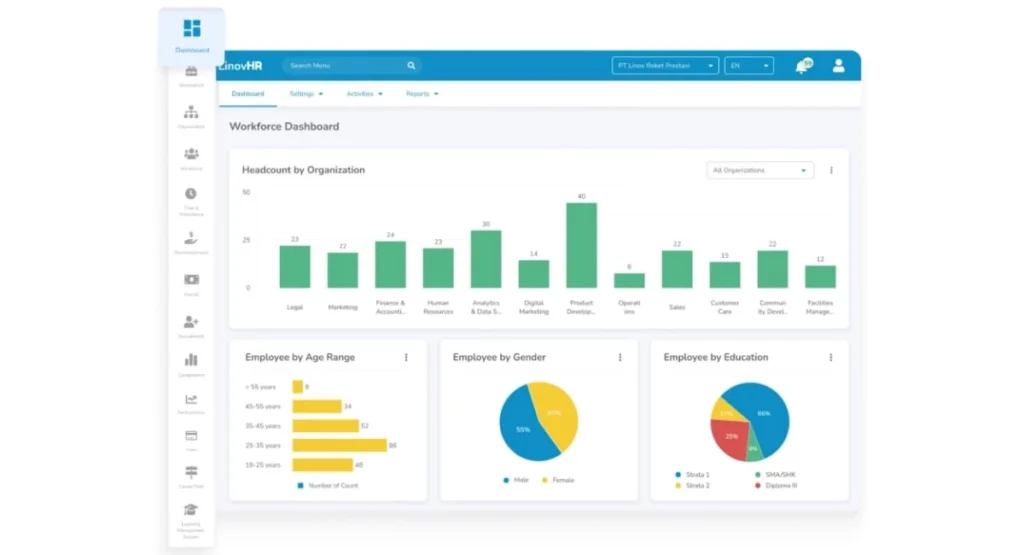
LinovHR is an HRIS and talent management software designed to support end-to-end HR management, starting from the recruitment process, onboarding, attendance and payroll management, up to performance management.
For F&B businesses with complex organizational structures, such as multi-branch restaurants or franchise networks, LinovHR offers a system that can be configured according to the company’s specific workflow and needs.
This all-in-one approach is a distinct added value for F&B businesses that have previously relied on several separate applications to manage attendance, payroll, and employee data, which are prone to data entry errors.
LinovHR offers several modules that serve as solutions for F&B operational needs, here are the details:
- Personnel Administration & Organization Management: Stores and separates data between head office staff and staff at each outlet in a structured manner without obstacles.
- Recruitment Management & Digital Onboarding: Accelerates the recruitment process for waiters or chefs due to high turnover. Digital onboarding ensures new employees immediately understand the restaurant’s SOPs from day one.
- Mobile Attendance, GPS, & Geofencing: Allows outlet employees to clock in/out from a specific restaurant location point with a predetermined radius (geofence).
- Shift Management & Overtime Management: Useful to simplify split shifts or weekly rotating schedules. The overtime module can also accurately calculate extra hours for kitchen staff.
- Payroll, BPJS & PPh 21: Automatic wage calculation for monthly and daily staff, complete with BPJS deductions and PPh 21 tax calculations according to government regulations.
- Performance Management & Learning Management: Helps HR evaluate KPIs per outlet and presents digital training materials for employees regarding new menus or food safety procedures.
- Employee Self Service & HR Analytics: Staff can view shift schedules and payslips via mobile phones. Meanwhile, central management can monitor analytical dashboards regarding turnover trends or labor cost burdens in each branch.
The combination of these various features makes LinovHR relevant not only for the central HR team but also for outlet supervisors who need direct visibility into the attendance, schedules, and performance of their teams from mobile devices.
Because all modules can be managed end-to-end, the resulting data is also more consistent for reporting needs to central management, especially for F&B businesses managing dozens to hundreds of outlets simultaneously.
LinovHR offers flexible pricing depending on the selected modules and the scale of the company using it. Additionally, LinovHR also provides a free one-month demo to allow prospective users to assess and adapt the system to the company’s needs.
Here are the details of the pros and cons of LinovHR HRIS software:
| Pros | Cons |
| Has an offline attendance feature that is effective for use in areas with limited internet access | Initial setup takes longer due to the many complex features |
| Available in both cloud and on-premise formats, adapting to the company’s infrastructure needs | The large number of available modules makes the adaptation process take a bit more time |
| Practical and accurate payroll module for calculating salaries, bonuses, THR (holiday allowances), etc. | Advanced configuration for complex systems requires implementation assistance from the vendor |
| All-in-one nature, covering the entire HR process end-to-end in one ecosystem | For small companies with simple needs, some features might feel excessive (overkill) and not optimally utilized |
| Has a very complete performance management feature. Supports KPI, OKR, and Balanced Scorecard. | Pricing schemes and service packages should be confirmed directly with the vendor as they can vary depending on company needs |
| Flexible for use by companies of various scales, from MSMEs/startups to large enterprises | |
| A support team is available to assist 24/7 in case of problems |
LinovHR HRIS software is suitable for F&B businesses:
- Multi-outlet restaurants
- Cloud kitchens, franchises
- Companies with many subsidiary restaurants (Restaurant groups)
- Hotels
2. Mekari Talenta
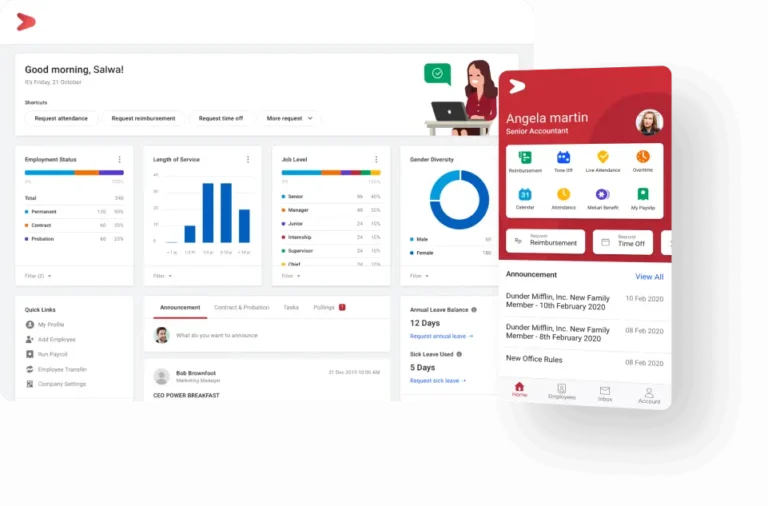
Mekari Talenta is a local HRIS vendor known for its relatively easy implementation process. This HRIS software is highly suitable for F&B businesses that want to integrate attendance, payroll, and HR administration into one platform.
Furthermore, the flexibility of Employee Self-Service (ESS) makes this software very mobile-friendly. Frontline F&B employees working in their respective outlets will find it very easy to monitor schedule distributions, request shift swaps, or request leave directly from their smartphones.
Here are some of Mekari Talenta’s features that are relevant to the F&B industry:
- Employee Database
- Attendance Management
- Leave
- Overtime
- Shift Schedule
- Payroll
- Employee Self-Service (ESS)
- Reporting
The HRIS vendor Mekari Talenta offers three types of packages with different advantages, namely Essential, Plus, and Talenta 360.
For pricing, you can consult directly with the Mekari Talenta sales team via the WhatsApp application.
This software excels in its Live Attendance feature, which is equipped with face recognition validation and geofencing, thus reducing attendance fraud. Additionally, its attendance tracking is connected to the payroll, minimizing recording errors.
The Mekari Talenta application also has a modern User Interface (UI), making it easy for users to operate. Another advantage is that it is integrated with other Mekari ecosystems (Jurnal, Klikpajak, POS, and Qontak), making it very suitable for the overall management of F&B companies.
However, Mekari Talenta HRIS software has weaknesses in its complex and less flexible customization. Its initial implementation also takes time.
Then, due to its complete and comprehensive modules, the learning curve is quite high during initial implementation.
Moreover, the subscription fee is relatively higher compared to its competitors. They only offer low prices in the first year. But in the second year, the price will increase.
Mekari Talenta also does not provide a permanently free package, making it less suitable for small culinary businesses.
Here are the details of the pros and cons of Mekari Talenta HRIS software:
| Pros | Cons |
| Quite complete and practical to use, has features that are comprehensive enough for small to medium company HRIS | Only available in cloud format, no on-premise option |
| Attendance is connected to payroll, making the payroll process more efficient and error-free | Prices tend to spike in the second year of subscription |
| Connected to other Mekari ecosystems (e.g., Jurnal and Klikpajak for finance/tax matters) | The learning curve is quite high due to complex modules |
| No need to subscribe to other Mekari products to be able to use this HRIS independently | Customization and system flexibility are very limited |
| Highly updated on regulatory changes, making it very suitable for local businesses | Support uses a ticketing system, not available 24/7, and if it exceeds the handling time limit, the process returns to the beginning (must re-submit) |
| Customer service is quite responsive, equipped with onboarding assistance | Features are good enough for small-medium companies but inadequate for large companies that need an HRIS with strategic functions (e.g., workforce planning, advanced analytics, or complex integrations) |
Mekari Talenta HRIS software is suitable for F&B businesses:
- Growing F&B businesses
- Large restaurant groups
3. Gaji.id

Gaji.id is a local HR software vendor that focuses on the ease of payroll and compliance with Indonesian labor regulations.
This software is highly relevant to the F&B industry because many restaurants use more complex daily wage schemes.
Features offered by Gaji.id include:
- Payroll with PPh 21 & BPJS calculation
- Attendance
- Shift Management
- Recruitment
- Performance Management
- Employee Self Service (ESS)
The HRIS vendor Gaji.id offers flexible pricing, according to the services taken. For details, you can consult directly with the sales team.
Users find the payroll feature on Gaji.id easy to use and it produces neater data, helping the HR team in decision-making. Its after-sales support service is also rated as responsive.
Additionally, Gaji.id offers a flat price for the first three years without any periodic increases at all, making it suitable for small-scale F&B businesses.
However, some users noted that a number of features could still be further developed, and the interface appearance could be improved to be more modern.
Furthermore, the Gaji.id software is not all-in-one because it focused on payroll services from the beginning.
Its performance management and recruitment features are also less superior compared to other local vendors. Yet, both of these features play an important role in monitoring employee performance and addressing high turnover rates.
The scalability of this HRIS software is also considered poor, making it less suitable for large restaurants that have many branches.
Here are the details of the pros and cons of Gaji.id HRIS software:
| Pros | Cons |
| Its payroll can be used for various restaurant payroll scenarios | Only available in cloud format, no on-premise option yet |
| Responsive after-sales support | Only provides basic HR features like payroll and attendance, less suitable for companies needing complex HR features |
| Offers a flat price for the first 3 years without any increase | Its User Interface is not as modern as other vendors |
| Its low price is suitable for MSMEs and small F&B businesses | Poor scalability for large F&B companies |
| Provides an offline attendance feature for attendance in areas with minimal internet connection | Performance management and recruitment features are less superior |
| Not all-in-one | |
| Limited integration with other software already in use |
Gaji.id HRIS software is suitable for F&B businesses:
- Medium-scale local restaurants
- F&B MSMEs
4. SunFish by DataOn

SunFish by DataOn is an enterprise-scale HRIS software with complete modules. Due to its characteristics, this HRIS software is suitable for large-scale F&B companies.
SunFish by DataOn’s features relevant to the F&B business include:
- Core HR
- Payroll
- Attendance
- Recruitment
- Learning Management System (LMS) for branch staff
- ESS
- HR Analytics
The official SunFish by DataOn website does not display prices openly. You can contact and consult directly with the sales team to get pricing details according to the company’s needs.
The advantage of this HRIS application lies in its high scalability, making it very suitable for multinational F&B companies wanting to expand to other countries.
The HRIS system from SunFish by DataOn is also available in cloud and on-premise models, making it more flexible for data storage.
In addition, this tool can also be integrated with ERP systems as well as financial software previously used by the company.
However, the main weakness of SunFish by DataOn is the limited flexibility of customization.
Then, because it is segmented for large-scale companies, F&B MSME businesses are less suitable to use it.
Furthermore, the application has the potential to slow down when used to process large amounts of data at once. This needs attention because from the start, this vendor’s segment is large-scale companies.
Here are the details of the pros and cons of SunFish by DataOn HRIS software:
| Pros | Cons |
| Already available in cloud, private cloud, and on-premise formats | Requires additional training for the HR team before implementation due to the completeness and complexity of the available features |
| High scalability | Limited customization |
| Ease of integration with ERP systems and financial software | The learning curve is quite high due to fairly complex modules |
| Highly suitable for large restaurants as it is enterprise-oriented | Because it is designed for enterprises, it is less suitable for small F&B businesses |
| Already holds ISO/IEC 27001 certification and SOC 2 Type 2 compliance reports, so system security is guaranteed | The application can potentially slow down when processing large data at once |
| Despite being on an international scale (focusing on Southeast Asia), regulatory compliance support for its payroll (PPh21, BPJS, and UMR) is adequate | Requires adjustments in setting up complicated payroll components (bonuses, overtime, meal allowances, and daily wage schemes) |
| Includes offline attendance support, suitable for recording attendance in areas with minimal internet connection | Based on several reviews, the price is considered too high and overkill for small businesses needing simple HR solutions |
SunFish by DataOn HRIS software is suitable for F&B businesses:
- National and multinational restaurant groups
- Hotels
5. KantorKu HRIS
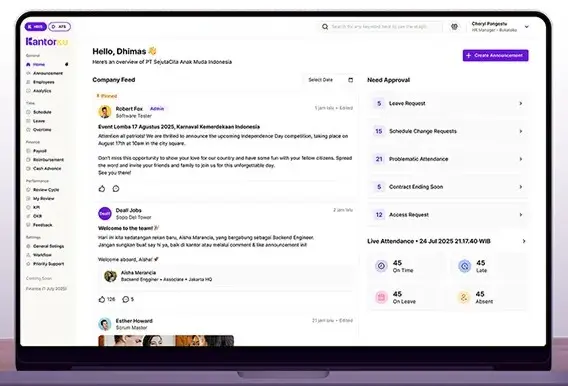
KantorKu HRIS is a local HRIS software known for its superiority on the mobile-friendly side. This is highly relevant to the F&B industry because this HRIS software can handle frontline employees scattered across various outlets.
Features relevant to the F&B industry include:
- Recruitment
- Shift & Attendance
- Payroll, Bonus, PPh21, and BPJS
- KPI/OKR
- Analytics
The HRIS vendor KantorKu offers four types of subscription packages, namely Starter for companies with fewer than 50 employees, Basic for companies with 50-100 employees, Essential for companies with 101-500 employees, and Suite for companies with more than 500 employees.
The price per package of KantorKu HRIS software is fairly inexpensive, starting from IDR 4,900 per employee/month, making it very suitable for small-scale culinary businesses.
KantorKu HRIS has a simple interface on the ESS application so employees can easily manage their respective data. This is very suitable for restaurants with employees spread across various branch outlets.
On the other hand, the weakness of KantorKu HRIS lies in its scalability. Because it focuses on a simple design, large-scale customization is deemed not as deep as other vendors focusing on enterprise HRIS software.
Additionally, this HRIS software relies heavily on cloud systems, so internet connection greatly affects its usage.
Here are the details of the pros and cons of KantorKu HRIS software:
| Pros | Cons |
| Implementation is very fast, only taking at least 3 days until the system is ready for use | Only available in cloud format, not available in on-premise format |
| Essential features such as Attendance, Payroll, Recruitment, up to performance are All-in-One within one system | HR features and report formats are too simple, not suitable for companies needing software with strategic analytical capabilities |
| Simple user interface on ESS | Lack of scalability for large F&B businesses |
| Mobile friendly for frontline employees in various outlets | Must subscribe to the suite (top) package for more advanced features |
| Suitable for small and growing businesses | Still focused on the local market, not suitable for multinational F&B companies |
| Quite an affordable price (starting from IDR 4,900 per employee/month) | |
| Data security is guaranteed as it holds ISO 27001 certification |
KantorKu HRIS software is suitable for F&B businesses:
- MSMEs
- Small or growing F&B businesses
6. Gadjian
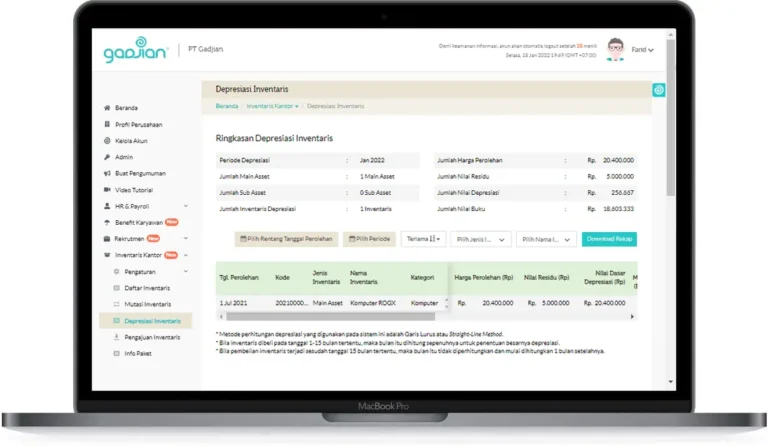
Gadjian is a local HRIS software that focuses on beginner-friendly payroll digitalization supported by an Employee Self-Service ecosystem feature.
Gadjian HRIS software is well-known for the ease of issuing digital payslips. This is very suitable for F&B businesses because easy payslip handover can increase the trust of employees with a daily wage system.
Here are the features relevant to the F&B industry:
- Payroll
- Attendance, Shift, and Work Patterns
- Leave, Absenteeism, and Sick Days
- Employee Performance Analysis
- Employee Mobile App (ESS)
Quoted from its official website, Gadjian offers several subscription packages at different prices, here are the details:
- Performance Appreciation: Suitable for companies wanting to start a structured system, starting from IDR 6,000 per employee/month
- Standard: Suitable for MSMEs, prices start from IDR 12,500 per employee/month
- Success: Suitable for medium to large scale businesses, starting from IDR 20,000 per employee/month
The advantage of Gadjian software lies in a simple UI and UX, meaning the HR team doesn’t need much time to adapt.
Then, this software has flexible payroll components per employee, which is very suitable for the F&B business. These components include allowances, overtime, meal money, up to PPh21 and BPJS arrangements.
Gadjian HRIS also offers flexible pricing, making it suitable for newly pioneering restaurants.
However, the drawback of this HRIS software is that its multi-branch management is not as flexible as other vendors.
Because it is designed for beginner administration processes, some of its modules are considered less comprehensive. Its scalability is also questionable. This indicates that Gadjian HRIS software is less suitable for enterprise-scale F&B businesses.
Also, the module customization is still minimal compared to other vendors. This needs attention because many other HRIS software providers offer more advanced features.
Furthermore, its analytics feature is still too simple and looks more like a payroll report than a strategic HR analysis.
Here are the details of the pros and cons of Gadjian software:
| Pros | Cons |
| Simple UI/UX that makes user adaptation easier | Only available in a cloud option, no on-premise choice |
| Flexible payroll for settings per employee | Multi-branch management is not as flexible as other applications with specialized multi-branch features |
| Flexible pricing according to business needs | Its analytics feature is less comprehensive, only in report format without strategic HR insights |
| Suitable for small F&B businesses due to simple modules | HR modules other than Payroll are still less superior |
| Offline attendance mode available for recording attendance during internet connection issues | Scalability is poor, making it unsuitable for large F&B companies |
| Prices are listed transparently (starting from IDR 12,500 – IDR 20,000 per employee/month) | Customization is still limited for the enterprise scale compared to LinovHR and SunFish software |
| A 14-day trial is available | UI is less modern compared to other HRIS applications |
Gadjian HRIS software is suitable for small-scale F&B businesses wanting to gradually try transitioning from manual systems to a digital platform.
7. GreatDay HR
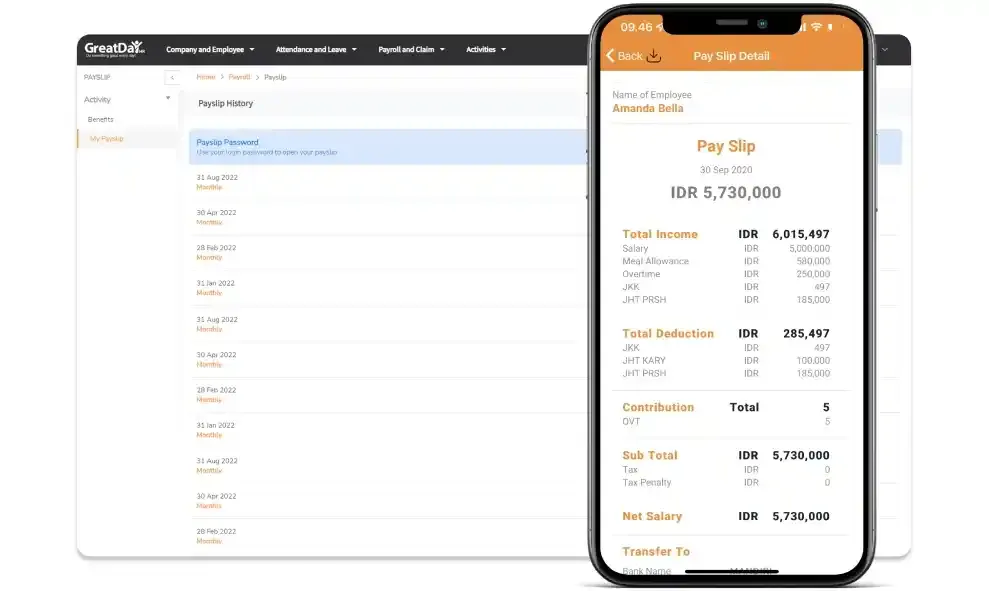
GreatDay HR is an HR management platform that focuses on attendance recording supported by the development of mobile HR capabilities.
Due to its mobile-first design, this HRIS software is highly suitable for managing employees with many scattered branches.
Some relevant features used in the F&B business include:
- Core HR
- Recruitment
- Attendance
- Leave & Overtime
- Payroll
- Benefits
- Performance Management
GreatDay HR offers prices starting from IDR 25,000 per employee/month. However, you can contact the sales team for customization options and price adjustments.
GreatDay HR’s HRIS software is equipped with face recognition as well as liveness detection in the Attendance feature. This can reduce attendance fraud because the validation is guaranteed.
Additionally, there is an Earned Wage Access (EWA) program that allows employees to withdraw a portion of their salary before payday. This is very suitable for the F&B industry where employees need cash flexibility with daily or weekly wage systems.
The scalability offered by GreatDay HR is also highly flexible. Clients can upgrade their subscription packages as the business grows.
However, the main weakness of this HRIS software is its heavy dependence on internet connections for its operation. If the internet signal is bad, features like attendance can be disrupted.
Furthermore, the dashboard display on the desktop is still too simple. This is a weakness because it reduces the capacity for in-depth analysis.
Here are the details of the pros and cons of GreatDay HR software:
| Pros | Cons |
| Mobile friendly, making it suitable for frontline employees in outlets | Only available in a cloud option, no on-premise choice |
| Face recognition and liveness detection prevent attendance violations | Heavily dependent on internet connection for using the Attendance feature |
| Earned Wage Access (EWA) allows employees to withdraw salaries before the payday period | Features are limited to basic HR like payroll and attendance, less suitable for companies needing specific HR solutions |
| Good and flexible scalability because it can upgrade as the business grows | The dashboard display on desktop/computer is still too simple |
| Already has ISO 9001:2015 and ISO 27001:2013 certifications, ensuring its security | Focuses too heavily on mobile, making desktop use less superior |
| The price is quite cheap, making it suitable for small F&B businesses that don’t need complex HRIS systems | Less suitable for large F&B companies that have complex HR reporting procedures |
GreatDay HR software is suitable for F&B businesses with complex shift schedules.
8. HashMicro HRM
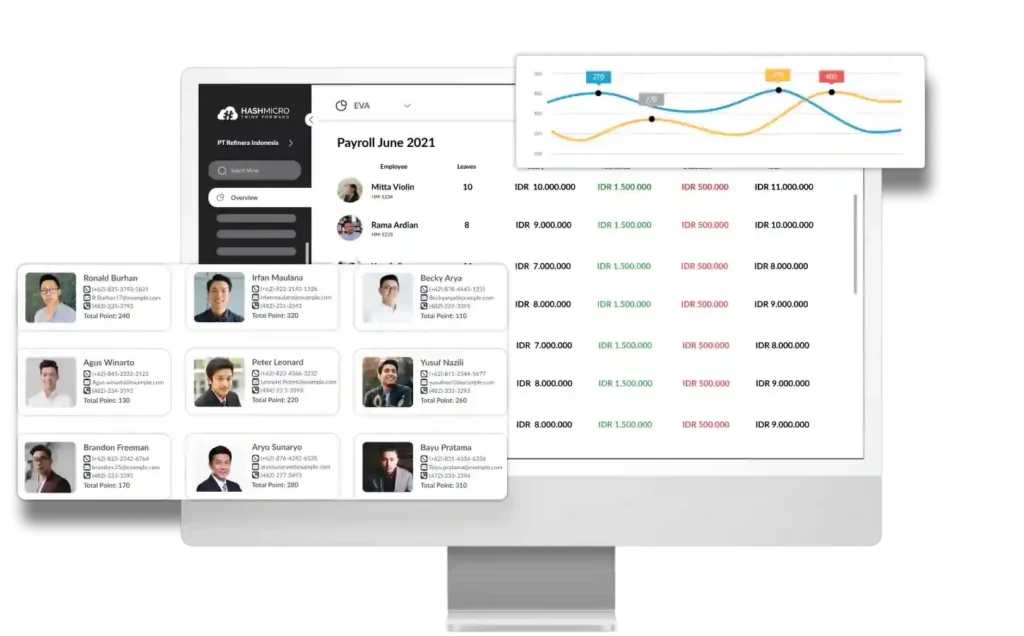
HashMicro HRIS software is a Human Resource Management (HRM) module that is part of the HashMicro ERP ecosystem. This module can be integrated with Accounting, Inventory, Purchasing, up to POS modules, depending on the needs of each company.
These characteristics make HashMicro HRM the right choice for F&B companies with complex operations that require detailed recording.
HashMicro HRM features relevant to the F&B industry include:
- Core HR
- Recruitment
- Payroll
- Attendance
- Shift scheduling
- Leave management
- Performance management
- ESS
- HR analytics
- ERP integration
HashMicro’s official website does not display prices for HRM software services. However, you can contact the HashMicro sales team for further discussions regarding service prices.
The main advantage of HashMicro HRM is the high level of customization that can be tailored to the workflow of each restaurant.
Then, HashMicro HRM offers high customization with support for multi-currency and multi-branch payroll.
Additionally, there is an Artificial Intelligence (AI) feature called Hashy AI to make it easier to submit leave, claims, and overtime via chatbot. This is very helpful for frontline employees for various submissions.
However, there are some weaknesses in this software, namely the implementation process is longer and more complicated compared to other HRIS.
Furthermore, users cannot just use the HRIS module alone and must use the entire HashMicro ERP ecosystem. This is very ineffective for small to medium F&B businesses.
Then, the implementation cost is quite high for small F&B businesses when compared to other HRIS vendors.
Here are the details of the pros and cons of HashMicro HRM software:
| Pros | Cons |
| Integrated into the entire HashMicro ecosystem | The HashMicro HRM module only provides a cloud option. If an on-premise format is needed, you must use HashMicro ERP |
| Customization is highly flexible according to company needs | If you do not use the overall HashMicro ERP module, the HRIS software’s performance is not maximized |
| Has the Hashy AI feature to facilitate frontline employees regarding submissions | The implementation cost is not too high, but to use the HRIS module effectively you must subscribe to the ERP system, so it is not cost-efficient |
| High customization supports multi-currency & multi-branch payroll | More complicated implementation due to complex features |
| Its complete ecosystem makes it easier to connect HR data with other business processes | Features that are too complex are not suitable for MSMEs that need simple solutions |
| Offers annual package pricing, which needs to be compared with per-employee packages from other vendors |
HashMicro HRM software is suitable for F&B businesses:
- Restaurant groups
- Multi-branch F&B companies
- Businesses that require ERP system integration
9. Rippling
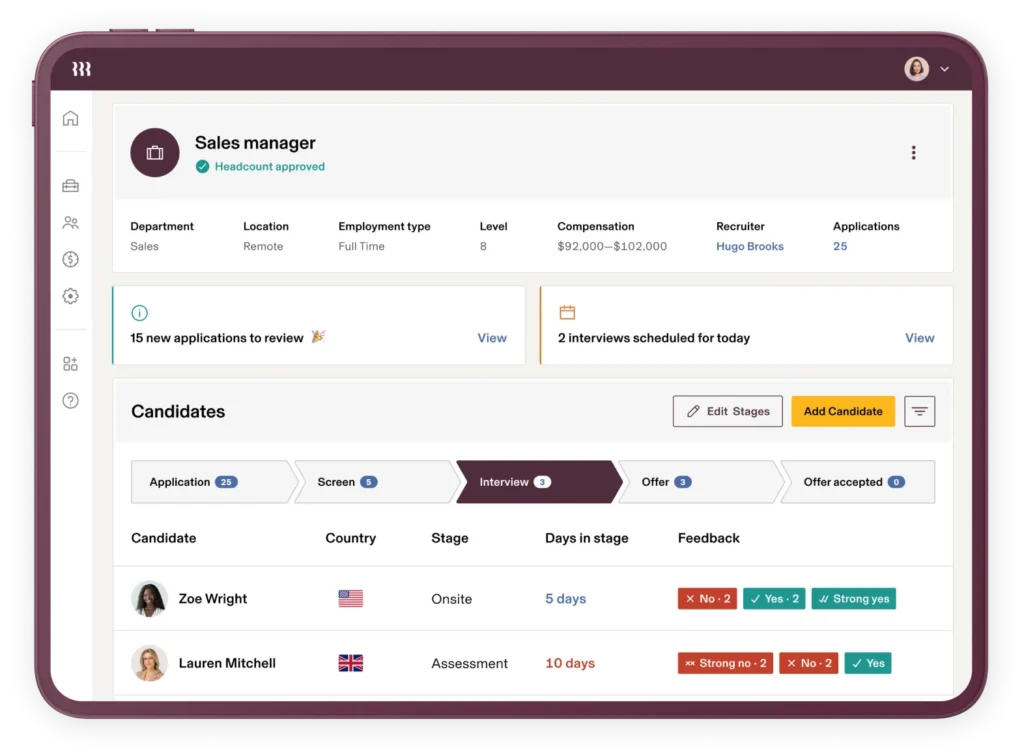
Rippling is a global HR platform that combines HR, payroll, IT management, and workforce management in one cloud-based system. This platform is designed for multinational companies supporting international payroll as well as contractor management.
This is highly relevant for F&B companies that have branches in several countries.
Some Rippling features relevant to the F&B business include:
- Core HR
- Global payroll
- Time & Attendance
- Scheduling
- Workforce Management
- Recruitment
- Benefits management
- HR reporting
For pricing, Rippling offers two types of subscription packages:
- Base platform: Starting around IDR 143,900/user/month
- Complete HR + Payroll + IT package: Around IDR 359,900 to IDR 719,700/user/month
According to user reviews, Rippling has a modern and intuitive interface, making its operation easy.
In addition, the automation of HR, IT, and Finance processes can be done in one platform at once, making work simpler. An example is when a new waitress is hired, the payroll, benefits, and ESS access data are automatically configured and recorded.
The live chat feature provided is also an added value as it can respond to various complaints and technical issues quickly.
However, there are some crucial weaknesses of Rippling HRIS software for F&B businesses. The system is more suitable for fixed salary systems, making it less relevant to daily or weekly wage systems as implemented by some restaurants.
Also, the detailed pricing is not transparent. This becomes a drawback for businesses with limited budgets because they cannot estimate the price and benefits obtained.
Furthermore, there is no “Local Payroll” support in Indonesia yet, so its payroll process is not as comprehensive as local HRIS that are already compatible with Indonesian regulations.
Here are the details of the pros and cons of Rippling HRIS software:
| Pros | Cons |
| Enterprise system suitable for multinational F&B companies | The modular pricing system (per-module) can make final costs higher |
| Modern and intuitive interface, making it easier to use | Less supportive of daily/weekly wage systems |
| Automation of HR, IT, and finance are integrated, so various activities that must go through these three steps can be done automatically | Less relevant for local companies because it is not compatible with Indonesian regulations |
| Live chat feature to respond to complaints and issues quickly | Less suitable for MSMEs because it is designed for enterprises |
| Payments are made using USD, so they must be adjusted to the Indonesian currency |
Rippling HRIS software is suitable for F&B businesses:
- International F&B franchises
- Multinational F&B corporate groups
- Companies with employee domiciles in various parts of the world
10. Darwinbox

Darwinbox is a cloud-based Human Capital Management (HCM) platform that supports the entire employee lifecycle process end-to-end.
This platform is widely used by enterprise companies in the Asian region, and is suitable for F&B companies that have many branches and employees.
Some Darwinbox features relevant to the F&B industry are:
- Core HR
- Payroll
- Time & Attendance
- Scheduling
- Recruitment
- Onboarding
- Performance management
- ESS
The official Darwinbox website does not state exact price ranges. For details, you can make an offer directly to the Darwinbox sales team.
The advantage of Darwinbox is that the application can run in areas with minimal signal and on low-specification devices. This is highly relevant for multi-branch F&B businesses with many frontline employees.
Then, there is an AI shift scheduling feature that can adapt to the rush hour patterns of each outlet. This perfectly matches restaurant operations with dynamic rush hour patterns.
Additionally, although not a local vendor, Darwinbox already has a specific Indonesian payroll system that can handle PPh 21, BPJS, and minimum wage arrangements for each region.
However, there are several weaknesses of Darwinbox HRIS software. First, it is less suitable for small-scale F&B businesses because the system is designed on an enterprise level.
In addition, there are shortcomings in the overly complex performance management feature. Manual updates are required, which can hinder the monitoring and assessment of frontline employee performance at each outlet.
Then, the technical issue response is quite long because all problems are handled by a central team located abroad.
Here are the details of the pros and cons of Darwinbox HRIS software:
| Pros | Cons |
| The system can operate in minimal signal areas, making it suitable for use in outlets with limited internet connection | Less suitable for small businesses due to complex features |
| High integration capabilities with various other software previously used by the company | Performance management is too complex and requires manual updates |
| Mobile app can be operated on low-spec phones | Loading speeds are still slow, especially when navigating pages |
| Has an AI shift manager that can arrange schedules flexibly and automatically according to company needs | Less intuitive UI display, complicating the user adaptation process |
| A specific Indonesian payroll is available which has been adapted to domestic regulations | Technical fixes can take a long time due to relying on a team abroad |
Darwinbox HRIS software is suitable for F&B businesses:
- National restaurant groups
- Enterprise F&B companies
- Regional standard F&B franchises
Which HRIS Software is Suitable for Your Company’s Needs?
After understanding the characteristics of each software, here is a summary that can help you determine the choice of the best F&B HRIS software according to the company’s specific needs.
| Needs | Software Recommendations |
| Most flexible HRIS for complex F&B operations | LinovHR |
| Payroll and Indonesian regulatory compliance | Gaji.id and Gadjian |
| Easy-to-implement HRIS | Mekari Talenta and KantorKu |
| Outlet employee shift and attendance management | LinovHR, Mekari Talenta, and GreatDay HR |
| F&B businesses with many branches (multi-outlet) | LinovHR, SunFish by DataOn, and HashMicro HRM |
| Restaurant groups or enterprise-scale F&B companies | LinovHR, SunFish by DataOn, and Darwinbox |
| F&B businesses that require ERP integration | HashMicro HRM |
| Employee Self Service (ESS) for employee experience | LinovHR, Mekari Talenta, and Gadjian |
| F&B companies with international operations | Rippling |
| Companies that require regional enterprise HCM | Darwinbox |
Features to Check When Choosing F&B HRIS Software

There are a number of features that should be a priority when considering an F&B HRIS application, especially for companies that manage many outlets, apply shift work systems, and have a large number of employees.
Here are some aspects that can be used as a reference during evaluation.
Multi Outlet Management
F&B businesses with many branches require a system that can group employee data based on outlet, manage organizational structures in each branch, and restrict access rights according to operational areas.
A good system is also capable of recording employee transfers between outlets without needing to create new data, as well as providing workforce reports based on their respective locations.
Shift Scheduling
Given the dynamic nature of F&B work patterns, an ideal HRIS system can arrange shift schedules easily, from rotating shifts and split shifts to cross-day shifts.
Mass scheduling features and shift swapping among employees are also important to accelerate the schedule arrangement process at each outlet.
Additionally, ensure the system can calculate overtime automatically and synchronize shift schedules directly with the payroll.
Mobile Attendance and Location Validation
Frontline F&B employees generally work directly at the outlet, making mobile-based attendance systems a primary need.
Features such as GPS attendance, geofencing, geotagging, and face recognition can help validate that employees are truly present at the work location.
Offline attendance capabilities are also important to anticipate internet connection constraints. Data must still be able to integrate into the payroll once the connection becomes available again.
Payroll That Supports F&B Business Operations
Compensation schemes in the F&B industry tend to be more complex compared to other industries. The ideal payroll system is capable of managing daily and monthly wages, service charges, tips, meal allowances, incentives, and overtime automatically.
Compliance with BPJS, PPh 21, and minimum wage differences between regions is also a must-prioritize aspect, especially for businesses with outlets in various cities.
Recruitment and Digital Onboarding
The high turnover rate of frontline employees makes the recruitment process in F&B businesses occur frequently.
An Applicant Tracking System (ATS) and talent pool help accelerate the candidate screening process, while document collection and digital onboarding can shorten new employee adaptation time.
Placement features based on outlets and workforce needs monitoring also help the HR team plan recruitment more proactively.
Performance Management and Outlet Productivity
To monitor team performance at each outlet, an HRIS system should ideally be able to generate reports on attendance, tardiness, outlet productivity, up to turnover rates.
KPI features and performance appraisals can also help supervisors evaluate employees more objectively, while labor cost reports and payroll recaps make it easier for management to monitor operational efficiency.
HR Analytics and Dashboard
A comprehensive HR analytics dashboard helps management see the big picture of HR conditions in real-time, starting from headcount, turnover rates, absenteeism rates, labor costs, to productivity per outlet.
Overtime data, payroll summaries, and changes in HR trends are also important to support strategic decision-making.
Integration and Data Centralization
In order to connect with other systems already used by the company, an HRIS software ideally has an open API (Application Programming Interface) and integration capabilities with attendance machines, ERPs, accounting, and banking.
A single sign-on (SSO) feature also facilitates employee access to various company systems, while good data migration capabilities will ease the transition process from old systems.
Scalability and System Performance
A continuously growing F&B business requires a system that can manage many employees and process payroll en masse without experiencing a decline in performance.
Cloud-based systems facilitate the addition of new outlets or concurrent access by many users, while maintaining system stability as the business scales.
Implementation and Customer Support
Implementation quality also determines the success of HRIS software adoption. Ensure the vendor provides implementation assistance, data migration help, and training for both administrators and end-users.
The availability of a dedicated account manager, a clear customer support SLA, and post-implementation support are also important to ensure the system can be used optimally in the long term.
Summary of features that must be checked:
- Multi-outlet management
- Flexible shift scheduling
- Mobile attendance with location validation
- Payroll that supports F&B compensation schemes
- Recruitment and digital onboarding
- Performance management and outlet productivity reports
- HR analytics and real-time dashboard
- Integration capabilities and data centralization
- Cloud-based system scalability
- Implementation quality and customer support
Checklist of Questions During HRIS Software Demo
Before selecting and subscribing to one of the HRIS system providers, it is advisable to conduct a live demo session with the vendor.
Here is a checklist of questions you can ask so that the decision made is more targeted:
- Does the software support multiple outlets?
- Can each outlet have a different shift schedule?
- Can the payroll calculate service charges?
- Does the payroll support daily and monthly employees?
- Can attendance run when the internet connection is unstable?
- Is geofencing available?
- Can data be integrated with a POS?
- Are reports per outlet available?
- How much implementation time is needed?
- Are there additional costs for training and integration?
Manage Your F&B Business HR Operations Integrally with LinovHR
HR management in the F&B industry faces many challenges in every process. Managing frontline employees, constantly changing shifts, to multi-outlet payroll does not have to be done manually.
To answer these problems, F&B HRIS software can be a solution for more structured HR management.
HRIS software can answer various complex F&B business problems with various modules and features that bring administrative automation.
Beyond modules, HRIS software must be integrated and centralized to ease the process of recording and transferring data between F&B business branches.
LinovHR is here as an F&B HRIS software that supports end-to-end HR management, from recruitment, GPS and geofencing-based attendance, automated payroll, to performance management, in one platform that can be tailored to your business workflow.
Make LinovHR the F&B HRIS recommendation that helps your HR and restaurant operational teams work more efficiently across every outlet.
Schedule a LinovHR demo now to see how this platform can be customized to your F&B business needs.
Frequently Asked Questions (FAQ)
What is the main difference between F&B HRIS software and HRIS for general industries?
F&B HRIS software is specifically designed to accommodate the dynamics of the culinary and hospitality industries. The main difference lies in the system’s ability to manage highly complex shift schedules (such as split shifts or cross-day shifts), multi-outlet management features to monitor many branches at once, and payroll modules capable of calculating service charges, tips, and wages for casual daily workers (part-time).
Can restaurant HRIS apps prevent outlet employee attendance fraud?
Yes, most of the best F&B HRIS apps today are already equipped with location-based mobile attendance features. Using a combination of GPS tracking, geofencing, and face recognition, the system will lock or validate attendance so employees can only clock in if they are truly within the radius of the restaurant outlet.
Can F&B HRIS systems be integrated with cashier applications (POS)?
Yes, they can. Some ERP-based HRIS platforms (like EVA HashMicro) offer native integration with POS and inventory systems. Meanwhile, for end-to-end HRIS software like LinovHR or SunFish, integration with POS machines or other third-party software can be bridged through API (Application Programming Interface) systems to synchronize data such as commission distribution or service charge calculations.
How does HRIS software help F&B businesses reduce high employee turnover rates?
HRIS helps organize the entire employee lifecycle. With a systematic digital onboarding, transparency in salary and overtime calculations, and Employee Self-Service (ESS) facilities to easily apply for leave, the employee work experience becomes better and well-facilitated. On the management side, HR Analytics features allow HR to track attendance trends and workloads to prevent staff from burning out before they decide to resign.
Is F&B HRIS software suitable for use by MSME-scale businesses or small coffee shops?
Very suitable. There is a variety of software options tailored to business scales. For culinary MSMEs or single coffee shops, applications like Mekari Talenta, Gadjian, or Gaji.id offer very affordable monthly subscription models (SaaS) with fundamental features like mobile attendance and payroll. You do not need to immediately invest in a large-scale system when your business is just beginning to grow.