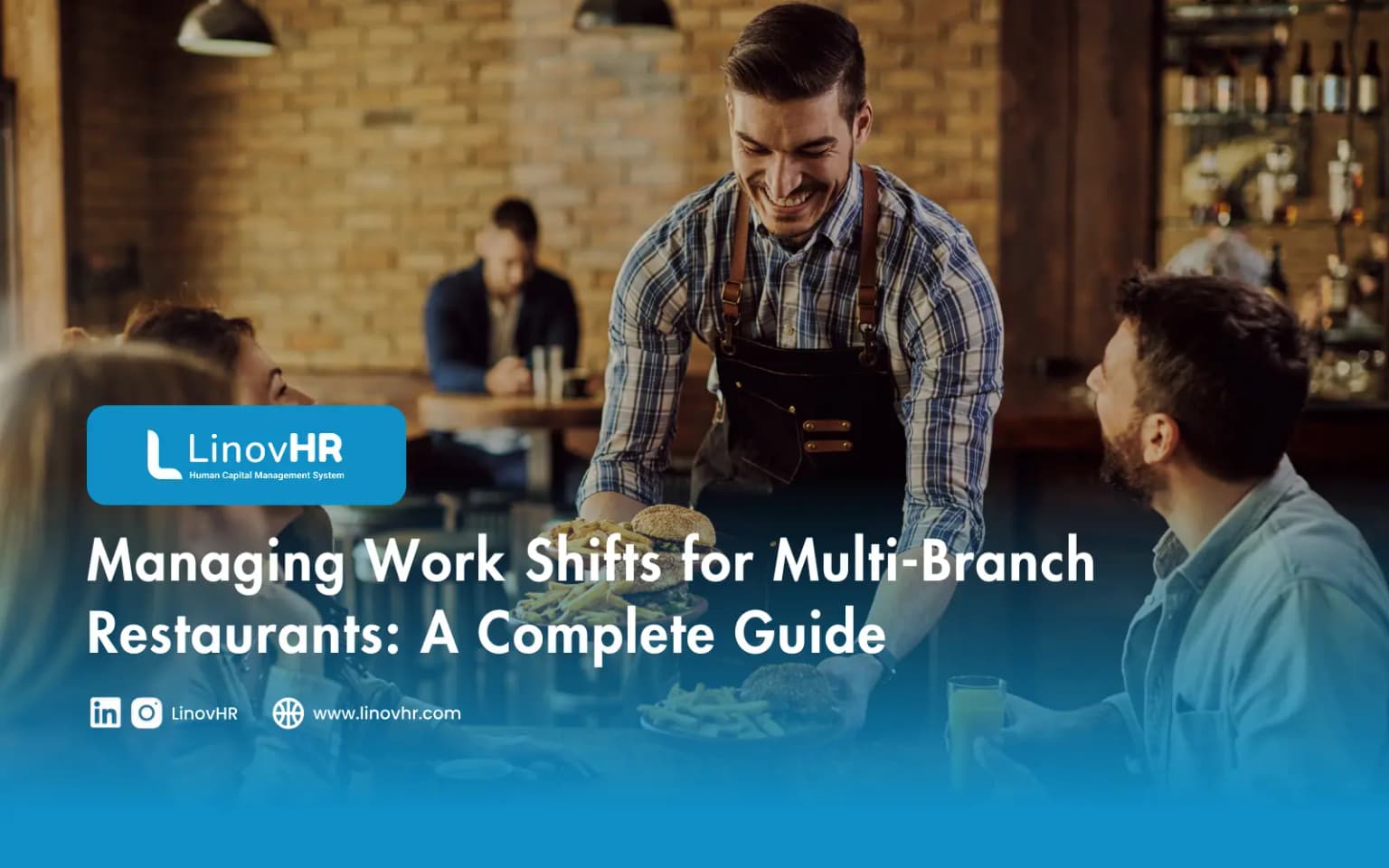
Restaurant shift scheduling means splitting a day’s operating hours into blocks, usually a morning, afternoon, and evening shift, so a restaurant can stay open and keep service consistent from open to close.
For a single outlet, an experienced manager can often make that work through habit and local knowledge. Once a restaurant group expands to several branches, though, that same instinct-based approach starts to break down, because head office now has to get the right number of people, in the right place, at the right time, without letting labor costs spiral.
This guide covers why shift scheduling gets so much harder as a restaurant chain grows, what tends to go wrong when it’s still managed manually, and a practical, HRIS-supported framework for building a shift system that holds up as the business scales.
Key Takeaways
- A shift pattern that works well for one branch rarely works for all of them. Each outlet has its own customer rhythm, peak hours, and staffing mix, and schedules need to reflect that.
- Manual shift management tends to break down in predictable ways: undocumented shift changes, chronic under- or overstaffing, and messy overtime and payroll calculations.
- Connecting shift scheduling to attendance and payroll through an HRIS closes most of these gaps and gives HR real-time visibility across every branch.
Why Scheduling Gets Harder as a Restaurant Chain Grows
A single restaurant can often get by on a shift pattern built from a manager’s experience and gut feel. That approach stops scaling the moment a second or third branch enters the picture, for a few concrete reasons.
Demand doesn’t move the same way twice
A 2025 operational research study of a restaurant chain found that customer demand fluctuates significantly not just hour to hour but day to day, which is exactly why a single fixed schedule, applied uniformly, tends to drift out of step with what a branch actually needs almost as soon as it’s published.
Every location has its own rush hour
Where a branch sits shapes its demand curve more than almost anything else. A branch near an office district will likely peak during the weekday lunch hour and go quiet on weekends. A branch inside a shopping mall often runs the opposite pattern. The heaviest traffic are on weekends and holidays, stretching from midday into the evening.
A branch built around delivery or takeaway may follow a different curve again, frequently picking up later at night. Apply one blanket schedule across all three, and at least one of them ends up either short-staffed or overstaffed.
Headcount is only half the staffing question
Restaurants also have to get the mix of roles right such as kitchen crew, cashiers, servers, baristas, supervisors, since each carries different responsibilities and different skill requirements.
The right staffing mix for a quiet Tuesday afternoon looks nothing like what’s needed to run a weekend promotion without the queue backing up at the register.
Operating hours stretch far beyond a typical business day
Many restaurants open early and close late, and some run around the clock. Covering that span without breaching working-hour regulations or letting service quality slip means the day has to be divided into carefully designed shifts, not just one long block.
| Factor | Why it complicates scheduling |
| Demand that shifts hour to hour and day to day | A single fixed schedule quickly falls out of step with reality |
| Branch-specific rush-hour patterns | Location type such as office district, mall, delivery-focused changes when a branch actually gets busy |
| Role-specific staffing needs | Every shift needs its own balance of kitchen, service, and supervisory coverage |
| Long, sometimes 24-hour operating windows | The day must be split into multiple shifts to stay compliant and keep service consistent |
What Manual Shift Management Actually Costs Restaurants
A lot of multi-branch F&B groups are still running schedules through spreadsheets, WhatsApp groups, or whatever system each outlet manager happens to prefer. That approach has a real, measurable cost.
McKinsey’s broader research on workforce planning found that staffing decisions today need to happen faster, be grounded in real data, and connect to the rest of the business’s operations, three things a spreadsheet or a group chat were never built to do well.
Leaning on manual methods for too long tends to surface the same handful of problems, again and again.
Shift changes get lost
When a swap or a last-minute change only happens over a chat thread, there’s rarely a clean record of it afterward. That leaves outlets exposed to double-booked shifts on one end and uncovered ones on the other, and makes it that much harder for a supervisor to reconstruct what happened when reviewing attendance later.
Staffing swings between too few people and too many
Get the headcount wrong on a given shift, and there are only two ways it goes wrong. Understaffed, and customers feel it immediately through slower service. Overstaffed, and the restaurant is quietly paying for hours that add nothing to the bottom line.
Overtime and payroll turn into a manual reconciliation job
Every undocumented shift change eventually has to be chased down before payroll runs. HR ends up cross-checking attendance logs, shift swaps, and base hours by hand. This slow down the progress even when nothing goes wrong, and error-prone when it does.
| Risk | What it leads to |
| Untracked shift changes | Double-booked shifts and harder attendance reviews |
| Chronic under- or overstaffing | Weaker service or wasted labor spend |
| Disconnected overtime records | Slower and less accurate payroll processing |
Building a Shift System That Scales Across Branches
Getting shift scheduling right across a growing number of outlets isn’t about working harder on the same spreadsheet, but it’s about building a repeatable, data-backed process.
1. Start with each outlet’s real numbers, not assumptions
Before drafting a single shift, gather the data that actually describes how a branch behaves: transaction history, reservations, delivery volume, upcoming promotions, public holidays, even weather patterns that tend to move foot traffic.
Once that’s mapped out, separating genuinely busy hours from quiet ones and staffing accordingly, branch by branch and role by role becomes far more straightforward than guessing.
2. Translate that data into a minimum headcount, by role and by hour
With demand patterns in hand, define the minimum number of people needed for each role during each operating hour.
A branch might need a full cashier and kitchen line-up through the lunch rush, and noticeably fewer an hour later.
The schedule should reflect that swing rather than staffing for the busiest hour all day long.
3. Choose a shift pattern that matches how the branch actually runs
Three shift structures cover most restaurant scheduling needs:
- Regular shifts: a standard eight-hour block (morning-to-afternoon or afternoon-to-evening), well suited to outlets with fairly steady traffic through the day.
- Split shifts: employees work the lunch rush, take an extended unpaid break through the slow mid-afternoon stretch, then return for dinner service. This is one of the more effective ways to avoid paying for hours nobody needs.
- Overlapping shifts: the incoming shift clocks in before the outgoing one clocks out, creating a buffer during the handover. This matters most during peak hours, when a clean transition keeps service from stalling.
Getting this choice right is as much an operations decision as an HR one. The right pattern protects labor cost and customer experience at the same time.
4. Put shift rules in writing, aligned with labor law
A written SOP covering shift swaps, rest days, and overtime keeps schedule changes from turning into disputes.
In Indonesia, Government Regulation No. 35 of 2021 sets the legal baseline restaurant employers need to build around: standard working hours are capped at 7 hours a day and 40 hours a week over a six-day week (or 8 hours a day over a five-day week), overtime is limited to 4 hours a day and 18 hours a week, and employees are entitled to paid overtime beyond those limits.
Putting clear internal shift policies in place around that baseline, instead of improvising outlet by outlet, cuts down on both compliance risk and everyday administrative friction.
5. Link scheduling directly to attendance and payroll
Shift management earns its keep when it’s wired into attendance and payroll rather than sitting next to them as a separate spreadsheet.
The ideal flow: a shift schedule is published, employees clock in against it, the system compares planned versus actual hours to flag lateness, early departures, and overtime, and that output feeds payroll automatically.
Beyond saving HR from manual data entry, it gives head office a live view of schedule compliance across every branch, without waiting on reports from each outlet.
6. Track the numbers that show whether the schedule is actually working
A shift schedule is only as good as the results it produces, so it’s worth reviewing regularly against a few core metrics:
- Scheduled vs. actual hours: how far real attendance drifts from what was planned.
- Overtime as a share of total hours: a persistently high number is usually a sign of understaffing, not just a busy week.
- Sales per labor hour (SPLH): total sales divided by total hours worked, a solid proxy for how productively a branch is using its staff.
These numbers make it far easier to spot which outlets need a headcount adjustment or a different shift pattern, instead of relying on a manager’s gut feeling.
7. Treat shift design as a retention lever, not just a coverage problem
Restaurant and F&B businesses known for relatively high staff turnover. KPMG’s outlook on the restaurant industry points to workplace culture and competitive benefits as essential for attracting and retaining talent in a sector where turnover and wage competition are persistent challenges.
A shift system that’s reasonably predictable, one that doesn’t chronically overload the same few people, does real work toward retention, alongside fair pay and room to grow.
8. Know when manual scheduling has hit its ceiling
There’s a point where the number of branches and employees outgrows what a spreadsheet or group chat can reasonably handle, often the same point where a manager starts losing hours each week just building next week’s roster.
That’s the signal to move toward a centralized, digital shift system, where scheduling, attendance, leave, overtime approvals, and payroll all sit inside one platform, and every change is logged automatically instead of living in someone’s chat history.
Common Mistakes That Undercut Multi-Branch Shift Scheduling
According to an essay published by McKinsey in 2022, errors in managing restaurant shift schedules are usually not caused by the difficulty of handling employees’ personalities, but rather by scheduling systems that have not yet been data-driven or fully integrated.
Copy-pasting one branch’s schedule onto another
Because customer patterns differ so much by location, a shift template built for one outlet rarely fits another cleanly. It just relocates the under- or overstaffing problem instead of solving it.
Scheduling from habit instead of data
Without transaction or foot-traffic numbers behind it, a shift plan is really a guess dressed up as a schedule, and it drifts further from reality the longer it goes unchecked.
Letting shift changes live in chat threads
A swap agreed over WhatsApp with no follow-up record is a miscommunication waiting to happen, and it leaves nothing for management to audit later.
Keeping scheduling, attendance, and payroll in separate systems
Every disconnect between these three means another manual cross-check for HR, and every manual cross-check is another chance for a wage or overtime error to slip through.
How LinovHR Supports Multi-Branch Restaurant Shift Management
Scheduling shifts for a multi-branch restaurant is never just about filling a roster. It means understanding demand at each outlet, defining staffing needs by role and hour, putting clear shift rules in place, and reviewing how well the schedule performs, as an ongoing discipline rather than a one-time project.
As branch and headcount numbers grow, doing all of that by hand stops being sustainable. That’s where an HRIS platform earns its place in the operation.
LinovHR is one HRIS provider in Indonesia built to support exactly this kind of workforce complexity, and has already worked with a number of F&B businesses moving away from manual shift planning.

The LinovHR Shift Management module, part of its broader Time Management suite, lets HR teams build and adjust shift schedules flexibly, with every change recorded in real time. Outlet supervisors get the flexibility to set shifts around their own peak hours, leave calendar, and available headcount, without head office losing central visibility.
Because the module connects directly with Attendance Management and Payroll, attendance data, lateness, overtime, and actual hours worked flow straight into payroll calculations, cutting down administrative work while improving the accuracy of workforce data across the board.
With scheduling, attendance, and payroll running on one connected system, restaurant operators can spend less time reconciling spreadsheets and more time on service quality, labor cost control, and growing the business.
Ready to see it in action? Book a demo with our team and find out how LinovHR can support your F&B business as it scales.
Frequently Asked Questions (FAQ)
What’s the real difference between a split shift and an overlapping shift?
A split shift covers two separate rush periods with an unpaid gap in between, useful for cutting labor cost during a restaurant’s slow mid-day stretch. An overlapping shift runs two shifts side by side for a short window so the outgoing and incoming teams can hand off without a service gap, most useful right before and during peak hours.
Does Indonesian labor law set specific rules for restaurant shift workers?
Yes. Government Regulation No. 35 of 2021 applies to shift-based F&B employees the same way it applies to other workers: standard hours are capped at 7–8 hours a day depending on the workweek length, overtime is capped at 4 hours a day and 18 hours a week, and employees are entitled to paid overtime and regular rest periods. Restaurants typically formalize the specifics, like how shift-based rest days rotate, in company policy built on top of this baseline.
Can one HR team realistically manage shift scheduling for many outlets at once?
It gets difficult to do well by hand once a chain passes a handful of branches, which is usually the point where businesses start delegating day-to-day shift decisions to outlet supervisors while keeping oversight centralized, typically through a shift management system that gives head office visibility without requiring it to build every schedule itself.
How often should a restaurant chain review its shift schedules?
Most operators benefit from a monthly review at minimum, checking metrics like overtime percentage and sales per labor hour, with a lighter weekly check-in around promotions, holidays, or other demand spikes a standard schedule wouldn’t anticipate.