HRIS software for the oil and gas industry is a digital system built to manage the full scope of HR governance in the sector on a single, integrated platform.
That scope covers employee data, K3 (occupational health and safety) certifications, onshore and offshore rotation scheduling, payroll with risk allowances, and safety incident reporting.
Systems built for the oil and gas industry need to handle a level of complexity far beyond what a typical HRIS in other sectors requires.
That’s because oil and gas operations come with a unique set of characteristics: work locations spread across offshore rigs and remote inland wells, extreme rotation patterns such as 14:14 (14 days on, 14 days off), a workforce dominated by contractors and outsourced labor, and multiple layers of safety regulation.
A single HR management mistake in the oil and gas industry can escalate into a serious safety incident. For instance, when a worker’s expired K3 certification goes undetected before they’re assigned to a high-risk location.
Unfortunately, the urgency of digitalization hasn’t always been matched by the right execution. Research from McKinsey in 2022 found that while nearly every oil and gas company has digitalized parts of its operations, about 70 percent of those initiatives are still stuck at the pilot stage.
The slow pace of HRIS adoption isn’t purely a technical problem, it also comes down to an immature approach to implementation and vendor selection from the outset.
This article rounds up 10 HRIS recommendations for the oil and gas industry worth considering, complete with features, price ranges, and each vendor’s pros and cons, to give your company a clear picture of the trusted HRIS options available in the industry.
Key Takeaways
- HRIS software for the oil and gas industry brings together conventional HR data and high-risk operational data such as K3 certifications, work rotations, and HSE incidents into a single system.
- Ten vendors are recommended for the oil and gas industry: LinovHR, SunFish by DataOn, GreatDay HR, Mekari Talenta, HashMicro HRM, Catapa, SAKA ERP, Gadjian, Gaji.id, and KantorKu HRIS.
- Software selection should weigh how complete each vendor’s K3, rotation, and contractor-management features are, alongside compliance with Indonesian regulations.
- Vendor fit still needs to be validated through a live demo built around real oil and gas operational scenarios.
Methodology for Rating These HRIS Recommendations
The oil and gas HRIS recommendations in this article weren’t put together based on brand popularity alone.
The assessment factored in genuine user experience, how complete each vendor’s features are for oil and gas operations, and how well each vendor understands the sector’s specific needs.
User Ratings and Reviews
User ratings serve as one indicator of overall satisfaction with a piece of software, while the number of reviews shows how much user experience is available as a reference point.
The pros and cons listed for each vendor in this article are drawn from user reviews, not a single opinion. As a rule, the more reviews available, the more representative the picture tends to be.
A high rating built on very few reviews doesn’t necessarily represent the broader user experience. Several local vendors on this list carry high ratings but still have a very small number of reviews, so that rating alone shouldn’t be treated as the main factor in your decision.
Features Assessed
Given how complex oil and gas operations are, this article’s feature assessment focuses on seven areas:
- K3 certification management
- Work rotation and fatigue management
- Payroll that handles risk allowances, BPJS, and Income Tax Article 21 (PPh 21)
- Digital HSE incident reporting
- Contractor and outsourced-workforce management
- Employee Self-Service (ESS) with offline mode
- Workforce analytics
Fit With Indonesian Regulations
Beyond the features above, how well a system aligns with Indonesian regulations is another key factor. This is assessed by looking at whether the system can handle:
- Income Tax Article 21 (PPh 21)
- BPJS Employment and BPJS Health contributions (Indonesia’s social security programs)
- Payroll compliant with Indonesian labor regulations
- Risk allowances
- K3 (occupational health and safety) regulations
- Law No. 1 of 1970 on Workplace Safety
- Regulation of the Minister of Energy and Mineral Resources (ESDM) No. 38 of 2017 on Safety Inspections of Installations and Equipment in Oil and Gas Business Activities
- Government Regulation No. 50 of 2012 on the Implementation of Occupational Health and Safety Management Systems (SMK3)
Data Sources Used
G2 data as of August 27, 2026 serves as the primary source for the rating and user-review data in this article.
Each vendor’s official website was used to verify feature claims and estimated pricing where that information is publicly available.
That said, features, service packages, and pricing for HRIS software can change at any time based on each vendor’s own policies, so it’s best to always confirm directly with the vendor before making a decision.
Methodology Summary
| Aspect | Source / Approach |
|---|---|
| User ratings & reviews | G2 (as of August 27, 2026) |
| Feature & pricing verification | Vendor official websites |
| Feature assessment focus | 7 oil and gas operational areas: K3, rotation, risk payroll, HSE, contractors, offline ESS, analytics |
| Regulatory compliance | PPh 21, BPJS, Law No. 1/1970, ESDM Regulation No. 38/2017, Government Regulation No. 50/2012 |
Comparison Table: HRIS Software for the Oil and Gas Industry
Before diving into each vendor, here’s a summary table of 10 HRIS software options for the oil and gas industry, along with their G2 rating, key features relevant to oil and gas operations, and the company segment each is best suited to.
| Software | G2 Rating | Features Relevant to the Oil and Gas Industry | Best-Fit Company Segment |
|---|---|---|---|
| LinovHR | 4.6/5 (12 reviews) | Contractor workforce management, 14:14/28:28 rotation Time Management integrated with payroll, risk allowance/BPJS/PPh 21, K3 LMS, offline ESS, HR Analytics | National KKKS and mid-to-large oil and gas service contractors |
| SunFish by DataOn | 4.5/5 (205 reviews) | On-premise deployment option, multi-country payroll, LMS, attendance, ESS | National-to-multinational KKKS/operators needing tight data control |
| GreatDay HR | 3.3/5 (3 reviews) | Live attendance with face recognition + liveness check, automated payroll, Earned Wage Access | Oil and gas companies with contractors spread across many locations (stable connectivity required) |
| Mekari Talenta | 4.8/5 (34 reviews) | Geofencing + selfie attendance, shift scheduling, payroll, ESS, reporting | Growing mid-size oil and gas service companies |
| HashMicro HRM | 4.3/5 (13 reviews) | Core HR connected to the ERP ecosystem, multi-currency/multi-branch payroll, HR Analytics, Hashy AI | Oil and gas companies wanting technician certification data linked to maintenance/asset systems |
| Catapa | N/A | Single-click payroll, flexible per-employee salary components | Oil and gas companies whose main pain point is rotation payroll complexity |
| SAKA (ERP+HR) | N/A | HR module connected to accounting & project management, per-project cost center | Project-based oil and gas contractors needing HR cost tracking per rig/site |
| Gadjian | N/A | Flexible payroll, offline attendance, shift, leave, ESS | Small-to-mid-size oil and gas support-service subcontractors/vendors |
| Gaji.id | 5.0/5 (2 reviews) | Complex daily payroll, BPJS, PPh 21, offline attendance, shift, recruitment, ESS | Small oil and gas contractors with daily wage schemes |
| KantorKu HRIS | N/A | Recruitment, attendance, payroll, performance, ESS, employee database | Small oil and gas support vendors with limited budget and implementation time |
Note: An “N/A” rating in the table above doesn’t mean a software’s quality is lower. It simply means that vendor isn’t listed on G2. For vendors with an N/A rating, it’s best to run a live demo to test the system’s fit with your company’s needs.
10 Best HRIS Software Recommendations for the Oil and Gas Industry
Each software on this list has a different value proposition. Some are better suited to mid-size KKKS (Indonesia’s oil and gas production-sharing contractors), while others are built for oil and gas operators looking for a solution for employees spread across onshore and offshore locations.
That’s why readers need to match their software choice to their business scale, operational complexity, and specific HR management needs.
1. LinovHR

LinovHR is a vendor that brings the entire oil-and-gas HR lifecycle together, from K3 certification to rotation payroll into one unified ecosystem.
With that capability, oil and gas HR teams no longer need to stitch together multiple separate systems just to get a complete picture of compliance, competency, and pay for their field workers.
LinovHR is built for mid-size to large companies that need an HR system aligned with Indonesian regulations while still being customizable to each organization’s own business processes.
Thanks to that customization flexibility, LinovHR can adapt to the specific characteristics that complex oil and gas operations demand.
Features most relevant to the oil and gas industry:
- Personnel Administration for permanent, rotational, and contractor employee data in a single database
- Time Management with 14:14 or 28:28 rotation settings, integrated directly with payroll
- Payroll that supports risk allowance, BPJS, and PPh 21 calculations in line with regulations
- A Workforce module to manage contractor and outsourced labor separately while keeping it within the same visibility system
- Offline attendance and offline ESS for workers at low-signal locations such as rigs or remote wells
- Mobile Attendance, GPS Attendance, and Geofencing to validate work location
- Organization Management for multi-location company structures
- Recruitment Management and Digital Onboarding
- Performance Management supporting KPI, OKR, and Balanced Scorecard evaluations relevant to assessing both rotational and contractor workers
- A Learning Management System (LMS) that can be used for K3 training, including for workers stationed offshore
- HR Analytics for reporting and data-driven decision-making
| Pros | Cons |
|---|---|
| The most complete module set among local vendors for covering the end-to-end oil-and-gas HR cycle (K3, rotation, contractors, risk payroll) in one ecosystem | Initial setup takes longer given the number of features that need configuring |
| Available as both cloud and on-premise, including offline attendance that works well in areas with limited internet access, such as rig locations | Advanced configuration for complex needs generally requires support from the vendor’s implementation team |
| A practical, accurate payroll module covering risk allowances, BPJS, PPh 21, bonuses, and holiday allowance (THR) | Pricing and service packages are custom, so cost estimates are only available after a consultation with the sales team |
| Based on G2 reviews, LinovHR has a user-friendly interface and a practical attendance process | |
| A comprehensive performance-management module spanning KPI, OKR, and Balanced Scorecard, relevant for evaluating both rotational and contractor workers | |
| A dedicated support team available 24/7 |
Pricing: LinovHR uses a custom pricing model based on the modules selected and employee count, so cost estimates are only available after a consultation with the sales team.
Best suited for: national KKKS and mid-to-large oil and gas service contractors that need a single integrated HR ecosystem to manage office staff, field workers, and contractors at once.
Feature and pricing source: linovhr.com
2. SunFish by DataOn

SunFish by DataOn offers an on-premise deployment option relevant for oil and gas companies whose employee data is sensitive or strategic and needs to comply with strict data-residency policies.
Relevant features:
- Multi-currency payroll
- Automatic support for the TER method of PPh 21 and BPJS
- Learning Management System
- Attendance
- Shift
- Recruitment
- Employee Self-Service
| Pros | Cons |
|---|---|
| Available in three deployment options: cloud, private cloud, and on-premise that relevant for strict data-control needs | Requires additional training for the HR team before implementation, given the depth and complexity of available features |
| Highly scalable with easy integration into ERP or other finance software | A fairly steep learning curve due to fairly complex modules |
| Stays compliant with Indonesian payroll regulations (PPh 21, BPJS, regional minimum wage) despite SunFish’s broader international/Southeast Asian footprint | The app can slow down when processing large volumes of data at once |
| Offline attendance support for recording attendance in areas with limited internet connectivity | Specific capability for extreme oil-and-gas-style rotation (14:14/28:28) isn’t well documented publicly, since SunFish is better known as a cross-industry HCM rather than an oil and gas specialist |
Pricing: Custom (Workplaze Pricing); requires a consultation with the sales team.
Best suited for: national-to-multinational KKKS/oil and gas operators that need an on-premise option.
Feature and pricing source: dataon.com
3. GreatDay HR
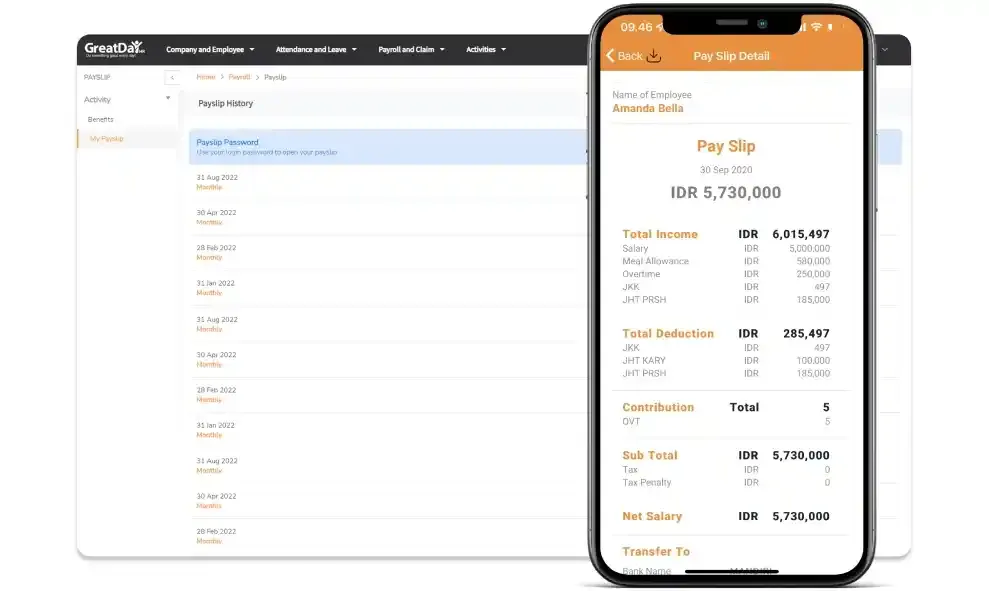
GreatDay HR is a vendor offering a mobile-friendly system for field workers and contractors spread across many locations.
That said, this strength also means the software leans heavily on internet connectivity, so it needs further testing for oil and gas locations with limited signal, such as offshore rigs.
Relevant features:
- Live attendance with face recognition
- Payroll
- Employee Database
- Employee Self-Service (ESS)
- Earned Wage Access (EWA)
| Pros | Cons |
|---|---|
| Mobile-friendly, making it well suited to managing contractor and field workers spread across many locations | Available only as a cloud deployment, with no on-premise option |
| Face recognition paired with liveness detection effectively helps prevent buddy punching among field workers | Heavily dependent on internet connectivity for the attendance feature; offline-mode support for low-signal locations like rigs needs direct confirmation |
| Earned Wage Access (EWA) lets workers draw pay before payday, relevant for daily contractor labor | Features lean toward basic HR functions like payroll and attendance, and are less suited to specific needs like K3 or HSE certification management |
| Good scalability and flexibility to upgrade as the business grows | Its strong mobile focus means it’s less capable for desktop-based administrative needs |
Pricing: Not published openly; requires contacting the sales team.
Best suited for: oil and gas companies with contractor labor spread across many locations, provided internet connectivity at those work sites is relatively reliable.
Feature and pricing source: greatdayhr.com
4. Mekari Talenta
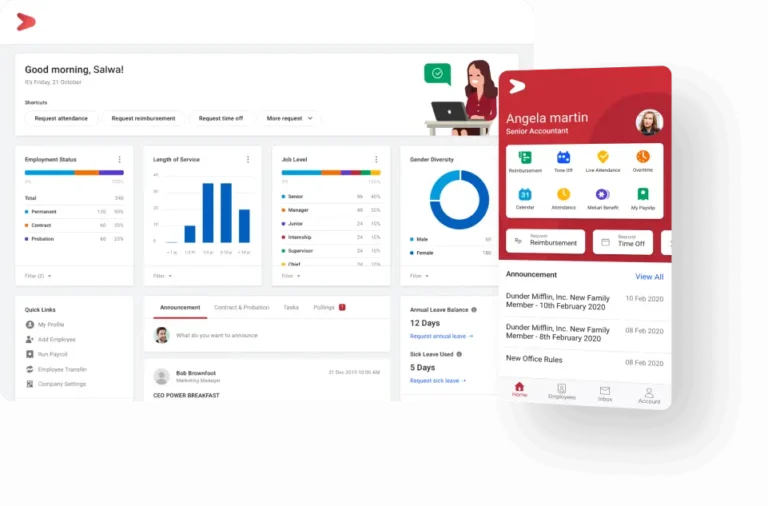
Mekari Talenta is a solid HRIS option for oil and gas companies that are scaling up.
That’s supported by its integration with Mekari’s broader finance-and-HR ecosystem, connecting with other Mekari products such as Jurnal and Klikpajak.
That said, Mekari Talenta’s HRIS system isn’t yet built for the operational complexity of large-scale KKKS.
Relevant features:
- Live attendance with face recognition and geofencing
- Shift scheduling
- Payroll
- Employee Self-Service (ESS)
- Reporting
| Pros | Cons |
|---|---|
| Fairly complete, practical features for small-to-mid-size companies | Available only as a cloud deployment, with no on-premise option |
| Attendance is directly integrated with payroll, making the payroll process more accurate and less error-prone | Subscription pricing tends to rise significantly in the second year |
| Connected to other Mekari products like Jurnal and Klikpajak for finance and tax needs, though it can still be used standalone without subscribing to other products | A fairly steep learning curve due to fairly complex modules |
| Fairly current with changes to Indonesian labor regulations | Customization and system flexibility are fairly limited |
| Customer support runs on a ticketing system and isn’t available 24/7; cases that pass the handling deadline risk having to be resubmitted | |
| Not yet sufficient for the strategic needs of large-scale KKKS, such as advanced workforce planning or complex integrations |
Pricing: Three package options are available (Essential, Plus, and Talenta 360), with custom pricing following a consultation about business needs.
Best suited for: growing mid-size oil and gas service companies.
Feature and pricing source: talenta.co
5. HashMicro HRM
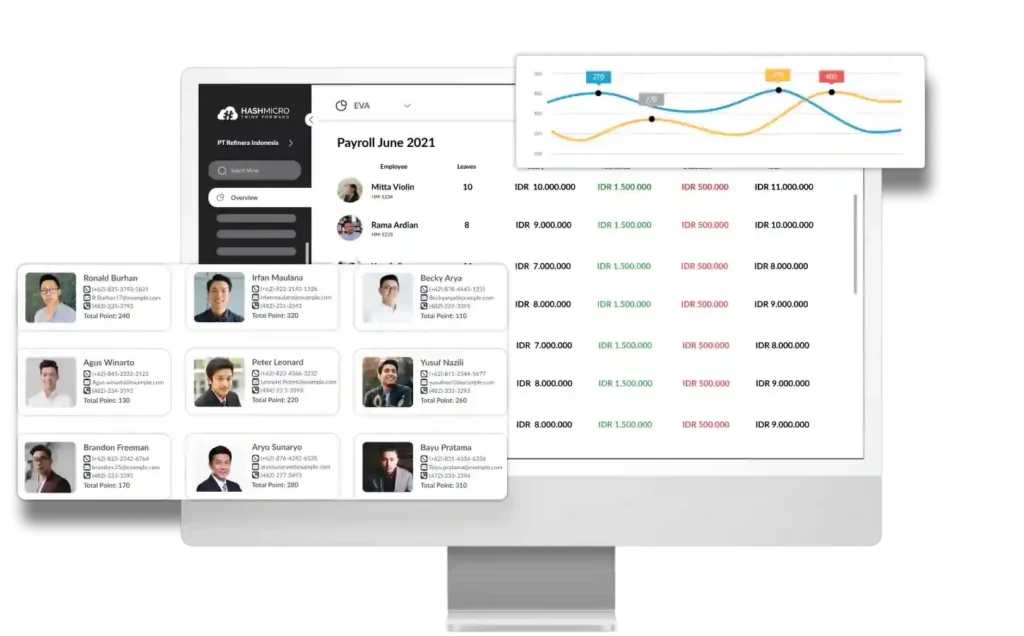
HashMicro is a vendor offering ERP services, with HRM as one of its comprehensive modules.
This service is relevant for oil and gas companies that need a solution integrating their overall company operations, especially for oil and gas businesses with complex characteristics.
Relevant features:
- Core HR
- Hashy AI (chatbot)
- Multi-currency and multi-branch payroll
- Attendance
- Shift scheduling
- Recruitment
- Employee Self-Service (ESS)
- HR Analytics
- ERP integration
| Pros | Cons |
|---|---|
| The HR module connects directly to HashMicro’s ERP ecosystem, making cross-functional data integration easier. It’s relevant for linking technician certifications with asset-maintenance schedules | Deployment is cloud-only, unless you adopt HashMicro’s full ERP ecosystem to unlock an on-premise option |
| Comes with Hashy AI (an AI-based chatbot) to speed up HR administrative processes | Data migration can take a while for companies with complex data |
| Supports multi-currency and multi-branch payroll, relevant for operations spanning multiple locations | Pricing follows an ERP model (license, user count, implementation cost), which can be less efficient if a company only needs the HR module |
| Comes with HR Analytics for reporting and decision-making needs | As part of a broad ERP ecosystem, teams that only need the HR module require more time to adapt to understanding the whole system |
Pricing: Custom, following an ERP pricing model; requires direct consultation with HashMicro’s sales team.
Best suited for: oil and gas companies that want technician certification data linked directly to their maintenance or asset-management system.
Feature and pricing source: hashmicro.com
6. Catapa

Catapa is an HRIS vendor well suited to oil and gas companies struggling with their payroll process.
This vendor focuses on solving the layered complexity of oil-and-gas payroll calculations, including risk allowances, rotation pay, and field overtime.
Relevant features:
- Single-click payroll that calculates salary, BPJS, and PPh 21 automatically within minutes
- Flexible, per-employee salary components
| Pros | Cons |
|---|---|
| A very fast payroll process thanks to its single-click concept, covering salary, BPJS, and PPh 21 calculations all at once | Its main focus is payroll, while K3, field rotation, and oil-and-gas-specific HSE modules aren’t its core strength, so these need to be tested directly for fit |
| A simple interface that’s relatively easy to implement, making it easy for users to adapt | Public documentation on HR modules beyond payroll (recruitment, performance, and similar) is still limited |
| Salary components can be flexibly configured per employee, suited to workforces with daily wage-calculation schemes | For large-scale oil and gas operations with complex multi-location needs, additional modules beyond payroll will likely still be required |
| Relatively affordable pricing for small-to-mid-size businesses |
Pricing: Not published openly; requires contacting the sales team.
Best suited for: oil and gas companies whose main challenge is rotation payroll complexity.
Feature and pricing source: catapa.com
7. SAKA (ERP + HR)

SAKA is an HRIS vendor experienced in solving a range of HR governance challenges in the construction sector.
Given that track record, the software remains fairly relevant for use by oil and gas companies.
Among the solutions it offers is labor-cost reporting per project or site, which could potentially be relevant for cost-recovery contexts under a Production Sharing Contract (PSC) between a KKKS and SKK Migas (Indonesia’s upstream oil and gas regulatory body).
That said, this specific capability still needs to be confirmed directly with the vendor before being treated as a basis for decision-making, since public information on SAKA remains very limited.
Relevant features:
- An HR module connected to accounting and project management
- Per-project cost center
| Pros | Cons |
|---|---|
| Its per-project cost-center concept could potentially be relevant for oil and gas contractors working on a project basis | Public information on features, pricing, and user testimonials is very limited |
| The HR module connects directly to the accounting and project-management system, potentially reducing the need for manual reconciliation between systems | Its relevance to PSC cost-recovery schemes hasn’t been independently verified and needs direct confirmation from the vendor |
| As a vendor with a fairly minimal digital footprint, extra due diligence — such as client references and a hands-on trial — is strongly recommended before deciding |
Pricing: Not publicly available; it’s recommended to contact the vendor directly.
Best suited for: project-based oil and gas contractors that need to track HR costs per rig or site.
Source: saka-erp.id
8. Gadjian
Gadjian is the HRIS software best suited to oil and gas subcontractors that are just making the move from manual administration to a digital system.
That said, it’s worth noting that Gadjian isn’t necessarily the top vendor in terms of scalability for the oil and gas industry compared with other applications offering more complete features.
Relevant features:
- Flexible per-employee payroll
- Offline attendance
- Shift
- Leave
- Employee Self-Service (ESS)
| Pros | Cons |
|---|---|
| A simple UI/UX that makes it easy for new users to adapt | Available only as a cloud deployment, with no on-premise option |
| Flexible payroll for configuring salary components per employee | Its analytics features aren’t especially comprehensive, offering reports without much strategic HR insight |
| An offline attendance mode for recording attendance when the internet connection is unreliable | HR modules beyond payroll (recruitment, performance, and similar) are still fairly weak |
| Pricing is listed transparently on the official website | Customization is still limited, making it less suited to enterprise-scale companies |
| A 14-day trial available before subscribing | The UI feels less modern than other HRIS applications, and oil-and-gas-specific modules (contractors, K3, extreme rotation) aren’t the product’s main focus |
Pricing:
- Standard Package: Rp12,500/employee/month
- Sukses Package: Rp20,000/employee/month
- Apresiasi Kinerja Package: Rp6,000/employee/month
Best suited for: small-to-mid-size oil and gas support-service subcontractors or vendors.
Feature and pricing source: gadjian.com
9. Gaji.id

Gaji.id is an HRIS vendor focused on simplifying the payroll process in line with Indonesian labor regulations.
This vendor is also known for consistent long-term costs, making it a good fit for small oil and gas contractors working with tight contract margins who are sensitive to unexpected software cost increases down the line.
Relevant features:
- Complex daily payroll
- BPJS
- PPh 21
- Offline attendance
- Shift
- Recruitment
- Employee Self-Service (ESS)
| Pros | Cons |
|---|---|
| Payroll can handle a range of scenarios, including the daily wage schemes relevant to short-term contractors | Available only as a cloud deployment, with no on-premise option yet |
| Supports PPh 21 and BPJS calculations | Features still lean toward basic HR functions like payroll and attendance, and are less suited to more complex HR needs such as K3 certification management |
| Customer support is rated as responsive, with hands-on implementation help from a human team rather than just a chatbot | Not yet as all-in-one as other vendors on this list |
| Onboarding is integrated with payroll on a single platform | The user interface is seen as less modern than other vendors |
| Offers a flat pricing scheme for the first 3 years with no increase — relevant for oil and gas contractors working with tight contract margins | Limited integration with other software a company may already be using |
| Offline attendance available for areas with limited internet connectivity |
Pricing: Not published in detail; it’s recommended to contact the vendor for the latest pricing scheme.
Best suited for: small oil and gas contractors with daily wage schemes.
Feature and pricing source: gaji.id
10. KantorKu HRIS

KantorKu HRIS is an HR system designed for small companies just starting to digitalize their HR management processes.
This software suits oil and gas support-service vendors that have just won a tender and need an HR system up and running quickly before deploying their team to a work site.
Relevant features:
- Recruitment
- Attendance
- Payroll
- Performance
- Employee Self-Service (ESS)
- Employee database
| Pros | Cons |
|---|---|
| An easy-to-understand interface that speeds up adaptation for both HR teams and employees | HR features and reports tend to be simple, without much depth for oil-and-gas-specific K3/HSE analytics needs |
| Practical employee data management, including easy tracking of status and tenure | Half-day leave settings still have some limitations |
| Supports bulk editing for managing large volumes of data at once, though the scheduling side still has room for improvement | Some advanced features are only available on the top-tier (Suite) package |
| Customer support gets positive feedback from users | Not much oil-and-gas-specific track record has been publicly documented |
| Fast implementation, with data migration completed in a matter of days and free implementation cost | |
| ISO 27001 certified for data security |
Pricing: Starting from Rp9,900/employee/month, with Starter, Basic, Essential, and Suite package options.
Best suited for: small oil and gas support-service vendors with a limited budget and implementation timeline.
Feature and pricing source: kantorku.id
Which HRIS Software Fits Your Oil and Gas Company’s Needs?
After looking at each vendor’s characteristics, the next step is mapping your company’s core needs against the most relevant option.
The table below summarizes the most common HR needs in the oil and gas industry and which vendor is the best fit for each.
| Main Company Need | Best-Fit Vendor |
|---|---|
| One complete oil-and-gas HR ecosystem, from K3 to rotation payroll | LinovHR |
| Tight data control / on-premise for sensitive employee data | SunFish by DataOn |
| Anti-fraud attendance validation for a dispersed contractor workforce | GreatDay HR |
| Scaling up and need an integrated finance-HR ecosystem | Mekari Talenta |
| Technician competency data needs to link to asset-maintenance schedules | HashMicro HRM |
| Rotation payroll and risk allowances are the main challenge | Catapa |
| HR cost reporting per project/rig for PSC cost-recovery needs | SAKA (ERP+HR) |
| Just migrating from Excel/manual processes on a limited budget | Gadjian |
| Daily wage scheme and need long-term cost certainty | Gaji.id |
| Vendor just won a tender, needs a system running before mobilization | KantorKu HRIS |
A single oil and gas company can easily have more than one need at once. In that case, it’s best to prioritize the most pressing need first, then evaluate whether the chosen vendor can also grow alongside the company’s future needs.
Features to Check When Choosing HRIS Software for Your Oil and Gas Business
Every oil and gas organization has different operational needs. Because these operational needs vary so widely, companies need to evaluate several features suited to implementation as HRIS software for an oil and gas business. Here are the aspects worth using as a reference during that evaluation.
1. K3 Certification and Competency Management
Make sure the system can track the validity period of workers’ mandatory certifications, such as Special Technical Personnel (TTK) or general K3 certification, complete with automatic notifications as expiration approaches.
An even more ideal feature can actually block assignment to a work location if a worker’s certification is no longer valid, so its function goes beyond passive record-keeping.
2. Extreme Rotation Scheduling and Fatigue Management
Unlike standard daily shift management, the system needs to support custom rotation patterns such as 14:14 or 28:28.
Ideally, the feature should also come with fatigue management, automatically flagging when a worker is approaching the maximum working-hour limit before mandatory leave.
3. Payroll With Risk Allowances, BPJS, and PPh 21
Payroll components for oil and gas workers are far more complex than in other industries.
Pay typically includes risk allowances that vary by job grade and work location, overtime pay that follows the rotation pattern, and automatic BPJS Employment and PPh 21 calculations in line with the latest regulations.
4. Digital HSE Incident Reporting Module
This feature takes the form of an incident and near-miss reporting form that can be filled out directly from a mobile device at the work site, complete with an automatic escalation workflow to the relevant authority and a dashboard showing incident trends by location or department.
5. Contractor and Outsourced-Workforce Management
Since the majority of field workers in the oil and gas industry are contractors, the system needs a vendor and contractor database kept separate from permanent employees.
That data still needs to stay within a single visibility system, though, including each individual’s contract term and certification validity.
6. Employee Self-Service With Offline Mode
The ESS feature should ideally support offline mode, given how many oil and gas work locations such as rigs or remote wells that have minimal or no internet signal.
Data entered offline will automatically sync once the device reconnects to the internet.
7. Workforce Analytics and Succession Planning
This feature is a dashboard showing retirement data by division and work location, combined with a competency-gap analysis.
Workforce analytics and succession planning help HR teams prepare replacements for senior staff before a real regeneration crisis hits.
8. API Integration With EHS/Operational Systems
Mid-to-large oil and gas companies typically already have their own operational or EHS system in place.
Make sure the HRIS can integrate through an API or data exchange, rather than replacing the systems already in place, so certification and incident data doesn’t end up scattered across different places.
9. Regulatory Compliance and Audit Readiness
Test whether the system can generate audit-ready reports, such as certification history and incident documentation, so the company is always prepared in case of an inspection from the Ministry of Energy and Mineral Resources (ESDM) or SKK Migas.
10. Multi-Location/Multi-Entity/Multi-Contract Scalability
Make sure the system can accommodate growth in the number of work locations, the addition of subsidiary or joint-venture entities, and variations in employment-contract types, without needing a full system migration every time something is added.
Summary: 10 Features to Check
- K3 certification and competency management with automatic reminders
- Extreme rotation scheduling and fatigue management
- Payroll with risk allowances, BPJS, and PPh 21
- Digital HSE incident reporting module
- Contractor and outsourced-workforce management
- Employee Self-Service with offline mode
- Workforce analytics and succession planning
- API integration with EHS/operational systems
- Regulatory compliance and audit readiness
- Multi-location/multi-entity/multi-contract scalability
Checklist of Questions to Ask During an HRIS Software Demo
Once you’ve narrowed down your options, use the checklist below during a demo session with each vendor, to make sure the software is genuinely tested against your real oil and gas operational scenarios.
- Does the software support both onshore and offshore operations?
- Does the software support a 14:14 or 28:28 rotation system?
- Can it automatically block an assignment if a worker’s K3 certification has expired?
- Can attendance recording still work when the internet connection is unstable?
- Is a geofencing feature available?
- What’s the estimated implementation timeline?
- Are there additional costs for training and integration?
Manage Oil and Gas HR Operations in an Integrated Way With LinovHR
From everything covered above, there are three key insights worth keeping in mind before choosing HRIS software for your oil and gas company.
First, characteristics unique to the oil and gas industry such as extreme work rotations, layered K3 regulations, and a workforce dominated by contractors call for a system genuinely designed for that reality, not a standard HR software forced to fit.
Second, as the McKinsey finding cited earlier in this article shows, most oil and gas companies running digitalization initiatives end up stuck at the pilot stage and never reach full scale. Choosing the right vendor from the outset is one way to avoid this problem.
Third, of the 10 vendors covered, LinovHR stands out as the option that brings the entire oil-and-gas HR lifecycle such as K3 certification, work rotation, risk-allowance payroll, and contractor management together into one unified ecosystem.
If your company wants to manage its oil and gas HR operations in a more integrated, regulation-compliant way and stay audit-ready at all times, schedule a free LinovHR demo and talk through your company’s specific needs with our team.
Frequently Asked Questions (FAQ)
What’s the best local HRIS software for mid-to-large oil and gas companies?
For mid-to-large companies, LinovHR is one of the more complete local HRIS options for the oil and gas industry, since it brings together K3, work rotation, risk-allowance payroll, and contractor-management modules in a single system. SunFish by DataOn is also worth considering, especially for companies that need an on-premise option for data-residency reasons. That said, fit still needs to be tested through a live demo based on your company’s specific needs.
Why should Indonesian oil and gas companies choose a local HRIS over a global vendor like SAP or Oracle?
Local vendors typically adapt faster to changes in Indonesian labor and oil-and-gas K3 regulations, such as PPh 21, BPJS, or provisions from the Ministry of Energy and Mineral Resources. Implementation and subscription costs for local HRIS also tend to be more affordable than for global vendors. That said, for multinational oil and gas companies that need standardized HR data across countries, a global vendor like SAP SuccessFactors can still be relevant, and is often combined with a local system to handle Indonesian compliance needs.
What’s the typical cost range for implementing HRIS at an oil and gas company?
The range varies quite a bit depending on scale and feature completeness. Software focused on basic payroll is usually priced from around Rp6,000 to Rp20,000 per employee per month. More complete HRIS built for oil-and-gas-specific needs, such as LinovHR, SunFish, or HashMicro, generally use a custom pricing model that’s only revealed after a consultation with the sales team, since it depends on employee count, the modules chosen, and implementation complexity.
What’s the difference between dedicated EHS software and an HRIS for managing K3 risk?
EHS (Environment, Health, and Safety) software generally focuses purely on managing operational risk, incidents, and environmental-health-safety compliance as its own standalone system. An HRIS for the oil and gas industry, meanwhile, manages HR data such as competency certifications, training history, and worker assignments that connects to that K3 risk. Ideally, the two systems integrate with each other through an API rather than replacing one another, since an HRIS’s strength lies in human data, while EHS’s strength lies in operations and incident reporting.
Is a local HRIS enough for a multinational oil and gas company operating in Indonesia?
For compliance with Indonesia-specific labor and K3 regulations, a local HRIS often actually has the edge, since it adapts faster to regulatory changes. However, if a multinational company needs one globally standardized HR system across countries, a more realistic approach is usually combining a local HRIS for Indonesian compliance with the parent company’s global HCM system, rather than choosing one exclusively.